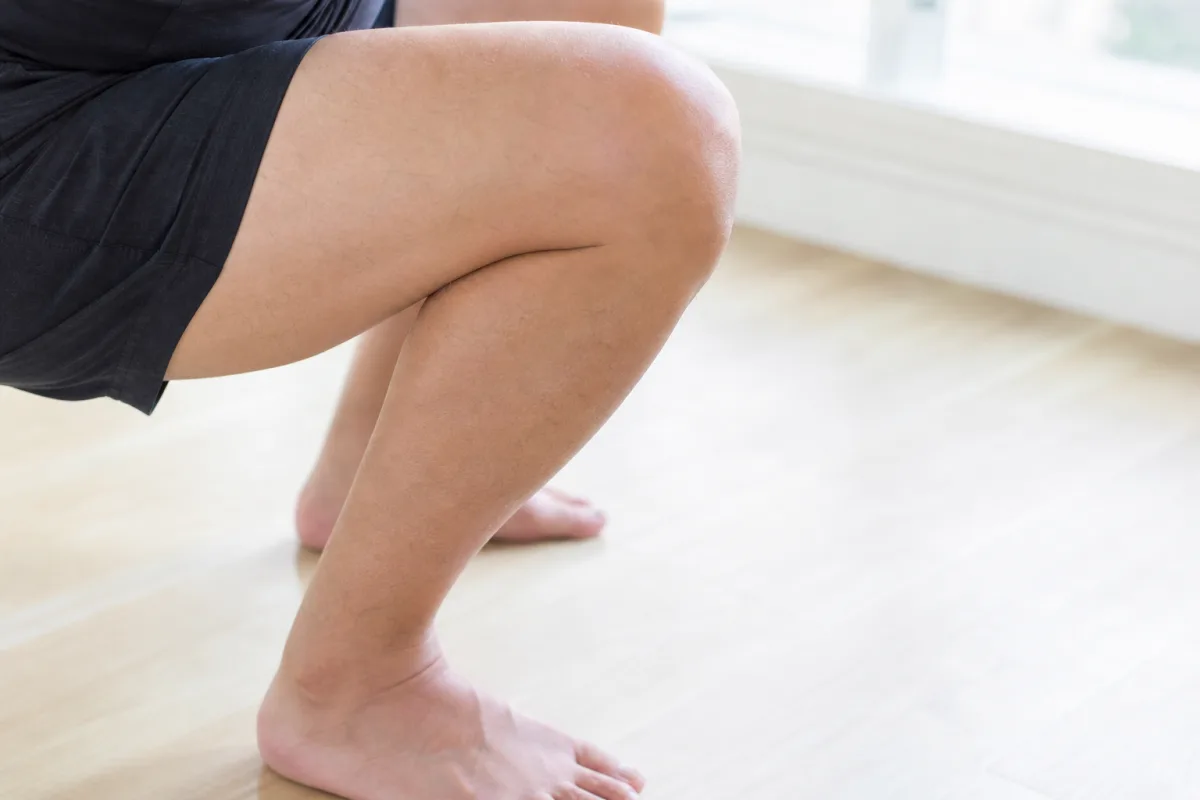
Knees that crack during squats are almost always making harmless noise: gas bubbles forming in the joint fluid, tendons sliding over bone as the knee bends, and cartilage surfaces gliding with normal texture. Painless noise without swelling is not damage. The combination to watch for is sound plus pain, swelling, catching, or giving way.

Clients bring this to me quietly, like a confession. They'll finish a set, glance around, and ask if I heard their knees on the way down. Someone at CoachCMFit once described her knees as "Rice Krispies in the milk," and she'd been avoiding squats for two years because of it. Two years of lost leg strength over a sound effect. That trade is the real damage, and it's the one nobody talks about.
What Is Actually Making the Cracking Sound?
The medical term for joint noise is crepitus, and it comes from a few ordinary sources. The sharp pop is usually cavitation: gas bubbles rapidly forming in the synovial fluid that lubricates the joint. The softer clicks are tendons and ligaments sliding across bony bumps as the knee travels through its arc. The fine crackle, the Rice Krispies one, is typically cartilage surfaces gliding over each other with the normal texture they develop over decades of use.
The pop itself was finally caught on camera in 2015. Researchers at the University of Alberta put finger joints inside a real-time MRI and pulled until they cracked. Every single crack coincided with the rapid formation of a gas-filled cavity in the joint fluid, an event lasting under a third of a second. The sound is physics, not breakage.
The more important study for lifters came from researchers at São Paulo State University and La Trobe University, published in Physical Therapy in Sport. In women with patellofemoral pain, knee crepitus was common, but it had no relationship to their function, physical activity level, or pain. The noise and the problem were two separate things. What crepitus did predict in related work was fear: people who hear their knees start protecting them, avoiding stairs, avoiding squats, avoiding load. The avoidance weakens the legs, and weak legs are a genuine knee risk factor, which makes the fear a better predictor of trouble than the sound.
The villain here is every gym bro and worried relative who ever said "that sound means bone on bone." That phrase has scared more people out of leg training than any actual injury. If cracking meant damage, every teenager cracking their knuckles would have ruined hands, and the research says they don't.
When Should You Actually Worry About Knee Noise?
Noise alone is static. Noise plus symptoms is signal. Here's the screen I run with every CoachCMFit client who brings it up.
| What You Notice | What It Suggests | What to Do |
|---|---|---|
| Painless cracking, no swelling | Normal crepitus | Keep training. Warm up better. |
| Pain at the moment of the sound | Possible cartilage or tendon irritation | Modify range, get evaluated if persistent |
| Swelling after noisy sessions | Joint irritation that needs attention | See a physical therapist or doctor |
| Catching or locking mid-rep | Possible meniscus involvement | Medical evaluation, soon |
| Loud pop during an injury, then rapid swelling | Possible ligament tear | Medical evaluation, immediately |
Pain has its own decision tree beyond noise, and I laid out the full WHERE, WHEN, and SCALE framework in how to train with knee pain. The short version: pain at 7 or higher out of 10, or pain at rest, goes to a professional. Pain in the 3-6 range during specific movements gets a modification and a retest a few weeks later.
Do Squats Damage Your Knees?
No, and the fear runs exactly backward. I took the full question apart in are squats bad for your knees, but the evidence summary is short: progressive squatting strengthens the quads, glutes, and the cartilage's support system, and strong legs are protective for knees, including arthritic ones. The knee that's at risk long term is the unloaded one sitting on the couch avoiding stairs.

What noise sometimes does flag is a tracking issue: the kneecap gliding slightly off its groove because the muscles steering it are imbalanced or the joints above and below aren't doing their jobs. Knees that dive inward on the way up, covered in how to fix knees caving in when squatting, and stiff ankles that force the knees to compensate, covered in how to improve ankle mobility, both change how the kneecap tracks. Fixing them doesn't just quiet some of the noise. It makes the squat stronger.
How Should You Train With Noisy Knees?
Train normally, warm up like an adult, and give the joint a few weeks of consistent loading before judging anything. Cold joints are noisy joints: synovial fluid thins and lubricates better once the tissue is warm, which is why the first squat of the morning crackles and the tenth doesn't.
CoachCMFit's Four-Phase Warm-Up
Every CoachCMFit lower body session opens with the same four phases: Mobility, Dynamic, Activation, Core. For noisy knees the sequence matters. Five minutes of easy cycling or brisk walking raises joint temperature, hip and ankle mobility drills clear the neighbors that force the knee to compensate, then bodyweight squats and glute activation rehearse the exact pattern before load touches it. Most clients report their knees are half as loud by the first working set, and that's the joint telling you the warm-up did its job.
From there, the loading follows the standard CoachCMFit 12-week progression: higher reps at moderate loads in the Foundation block while tissue adapts, then heavier work in Build and Challenge as the joint proves it's ready. Squatting to parallel with control beats forcing maximum depth on day one, and technique details live in how to squat with proper form. Hinge-dominant days using Romanian deadlifts and hip thrusts let you keep training hard while cranky knees calm down, without surrendering leg day.
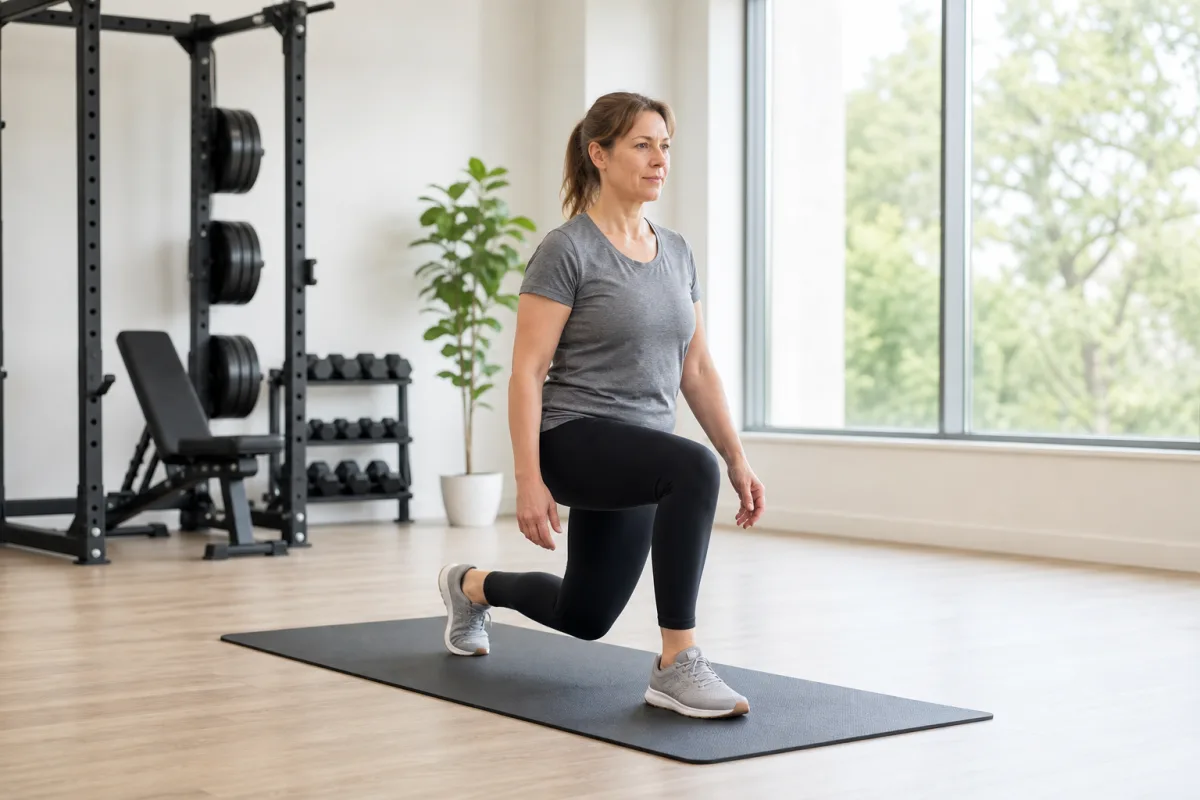
- Run the screen: pain, swelling, catching, instability. All clear means the noise is cosmetic.
- Warm up for real: 5 minutes easy cardio, ankle and hip mobility, 2 light sets before working sets.
- Keep squatting. Controlled depth, 12-15 reps at moderate load for 4 weeks, then progress.
- Strengthen the steering muscles: quads, glutes, and calves, 2-3 sessions per week.
- Recheck monthly. If noise picks up new symptoms, pain, swelling, or locking, get it evaluated.
- Stop narrating the sound. Two weeks of not reacting to it and most people stop noticing it.
In 13 years of coaching at CoachCMFit, I have never once seen painless knee cracking stop a client who kept training, but I've watched the fear of it cost people years of strength. Screen it, warm it up, load it, and let your knees be as noisy as they want on the way to being strong.