Improve ankle mobility by testing your dorsiflexion with the knee-to-wall test, then working four loaded drills daily before lower body training. Most people gain measurable range within two to four weeks, and the knee position that was falling apart under load usually cleans up with it.
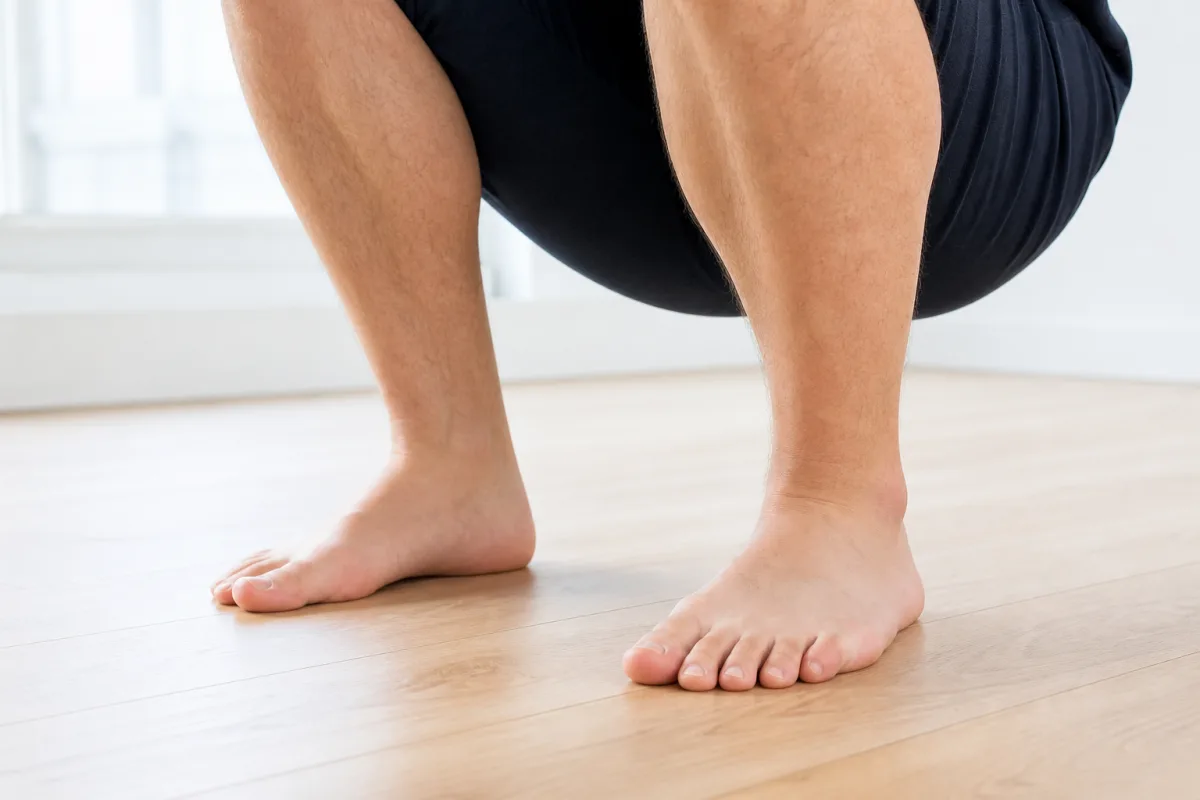
When a client tells me they cannot squat deep, I look at the ankles before I look at anything else. Not because hips never matter, but because ankle restriction is far more common and far easier to change. Years of shoes with a raised heel, an old sprain that healed stiff, and a lot of sitting will do it to almost anyone.
How Do You Test Ankle Mobility?
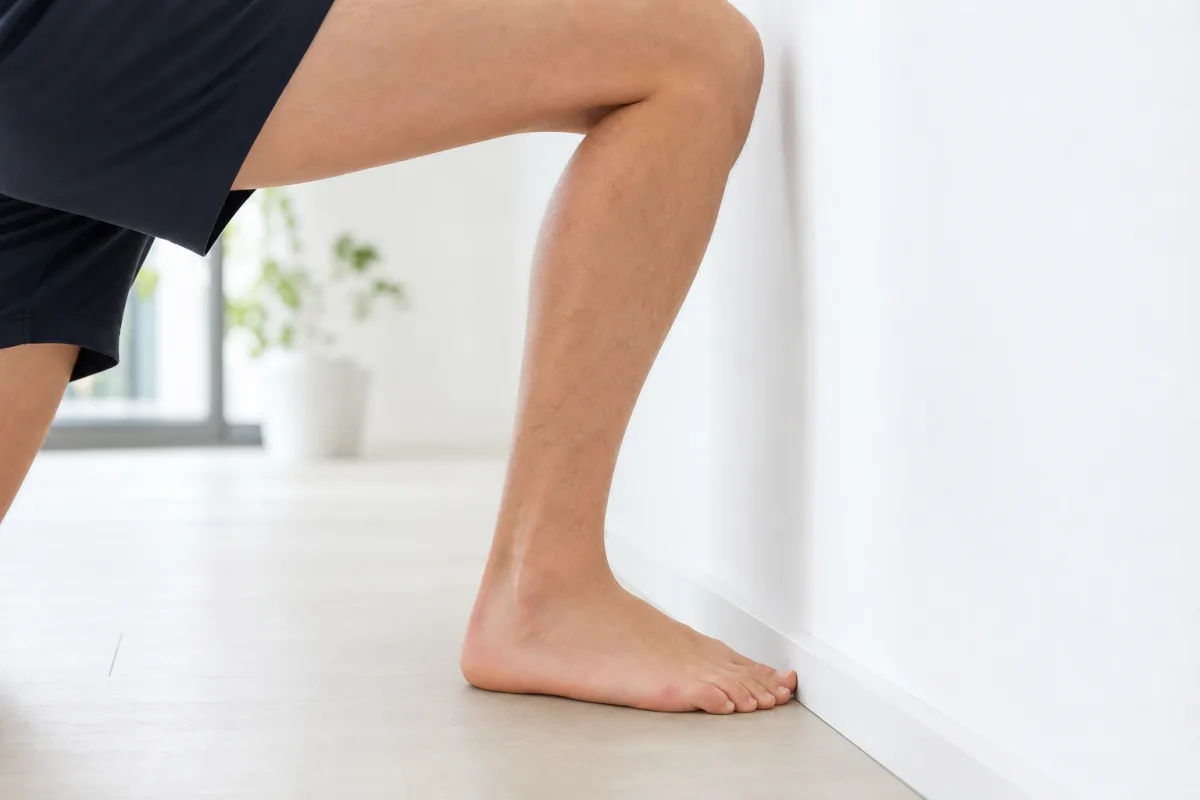
The knee-to-wall test, also called the weight-bearing lunge test, takes about twenty seconds per side and gives you a number to track.
Get into a half-kneeling position facing a wall, front foot flat, toes about four inches back from the baseboard. Drive your front knee straight forward toward the wall without letting the heel lift. If the knee touches the wall cleanly from four inches, you have enough dorsiflexion for most training. If it does not, or if the heel pops up before contact, that is your restriction and that is your baseline. Measure both sides, because asymmetry is common and it matters more than the raw number.
The villain is the "just stretch your hip flexors" answer. Somewhere along the way, every squat problem became a hip problem, and people spend months on couch stretches while their ankles stay locked. I am not against hip work. I am against skipping the joint that is closest to the floor and takes the most load, because when you skip it your body finds the range somewhere else and that somewhere else is usually your knees or your low back.

What Does Poor Ankle Mobility Do to Your Squat?
This has been measured directly, and the findings match what I see on the gym floor every week.
Macrum and colleagues published a study in the Journal of Sport Rehabilitation in 2012 that artificially restricted ankle dorsiflexion in 30 healthy participants using a 12-degree wedge, then measured squat mechanics and muscle activation against a flat-footed condition.
The restricted condition produced decreased peak knee flexion, increased knee valgus, and increased medial knee displacement, along with decreased quadriceps activation and increased soleus activation. The authors noted these changes resemble the patterns seen in people with patellofemoral pain.
Read that again, because the chain of consequences is the whole point. Restrict one joint and the body does not simply stop. It finds the movement somewhere else, in a plane it was not designed to produce it, and the knee is directly downstream. Knee cave under load is very often an ankle story, which is why how to fix knees caving in when squatting and this article are two halves of one problem.
The other consequence is torso angle. When the shin cannot travel forward, the hips have to travel backward to keep you balanced, which pitches the chest down and turns a squat into a bad morning. That is where the low back complaints start.
What Are the Best Drills to Improve Ankle Mobility?
Four drills, about three minutes, done before lower body training rather than after. Order matters here, and so does doing them warm.
| Drill | Dose | Target |
|---|---|---|
| Knee-to-wall rocks | 10 slow reps per side | The joint itself, actively |
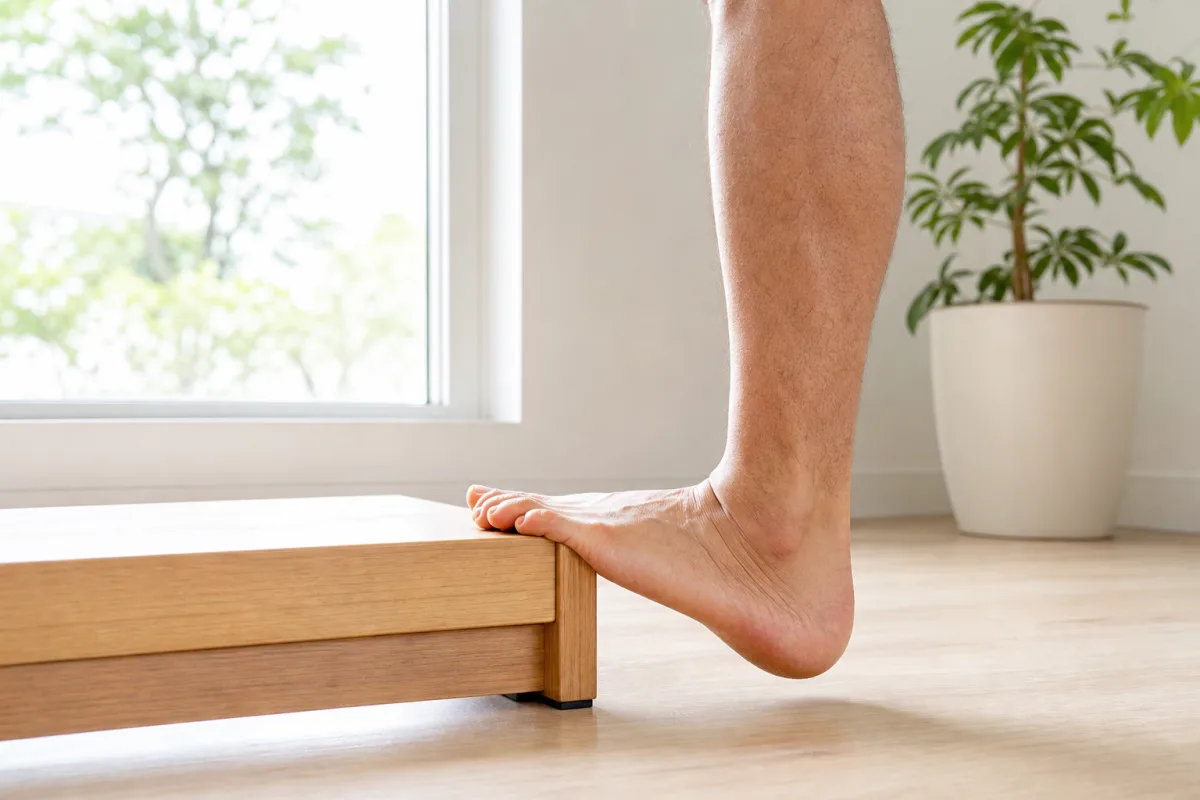
| Elevated calf stretch, knee straight | 30 sec per side | Gastrocnemius |
| Elevated calf stretch, knee bent | 30 sec per side | Soleus, the deeper limiter |
| Deep goblet squat hold | 30 sec, rocking gently | The pattern under light load |
The bent-knee version is the one people skip, and it is often the one that matters. The gastrocnemius crosses the knee, so straightening the leg biases it. The soleus sits underneath and does not cross the knee, so bending the knee takes the gastroc out of the equation and exposes the soleus. If your test barely improves after weeks of straight-leg calf stretching, the soleus is your restriction.
Load beats passive stretching here. The knee-to-wall rock and the goblet hold both put your bodyweight through the joint while it moves, which is what you are actually training for. If you want the full warm-up structure this sits inside, how to warm up before lifting lays out all four phases.
How Does CoachCMFit Program Ankle Work Across 12 Weeks?
Ankle drills live in the warm-up, not in a separate mobility session that nobody does.
CoachCMFit's Four-Phase Warm-Up
Every lower body session opens with Mobility, then Dynamic, then Activation, then Core. Ankle work sits in the Mobility phase on every single lower body day, which is where the consistency comes from. Nobody has to remember to do it, because it is printed on the workout and it happens before the first set.
Meanwhile the training itself gets adjusted rather than paused. During Block 1 of the CoachCMFit 12-week structure, which runs 12 to 15 reps for four weeks, I will regress a restricted client to a goblet squat to a box and reverse lunges instead of forcing a deep barbell squat they cannot own yet. Block 2 at 8 to 12 reps is usually where the range has caught up enough to load the full pattern. By Block 3 at 6 to 10, the heavy work happens in a position they earned rather than one they faked.
Heel elevation is allowed the entire time, and I want to be clear about what it is. A plate under the heels or a lifting shoe reduces the dorsiflexion the squat demands, which lets you train the pattern well today. It does not increase the range you have. Use it as an accommodation while you fix the actual restriction, not instead of fixing it. For the full depth conversation, see how to improve squat depth, and for the technique underneath it, how to squat with proper form.
When Is Stiff Ankle Mobility Not a Mobility Problem?
Sometimes the block is bony rather than muscular. Anterior ankle impingement, old fracture hardware, and advanced arthritic change can physically limit the joint, and no amount of stretching moves a bone spur. The signal is a hard, abrupt stop with pinching at the front of the ankle, as opposed to the stretchy, tolerable tension you feel in the back of the calf.
If your knee-to-wall test has not moved at all after six consistent weeks, or if the end range pinches sharply in front, that is a reason to see a physical therapist rather than to try harder. The same goes for any ankle pain at rest. In the meantime you can still train hard around it, and how to train with knee pain covers the substitutions, while how to build a mobility routine shows how to fit the daily work in without adding a session.
- Run the knee-to-wall test on both sides today and write down what you get.
- Do the four drills before every lower body session. Three minutes, not thirty.
- Include the bent-knee calf stretch. The soleus is the limiter most people never train.
- Elevate your heels while you train if it helps, and keep doing the drills anyway.
- Retest in two weeks. If nothing has moved in six, get the ankle looked at.
Ankle mobility is one of the few things in training where a small daily investment produces a visible change in a movement you care about within a month. Most people never test it, so they spend years training around a restriction that would have taken three minutes a day to fix.