To do a kettlebell swing, hinge at the hips with a flat back, hike the bell back between your legs, then snap your hips forward and let the bell float to chest height. The arms stay loose like ropes. The power comes entirely from the hips, and the bell swings back down into the next rep without stopping.
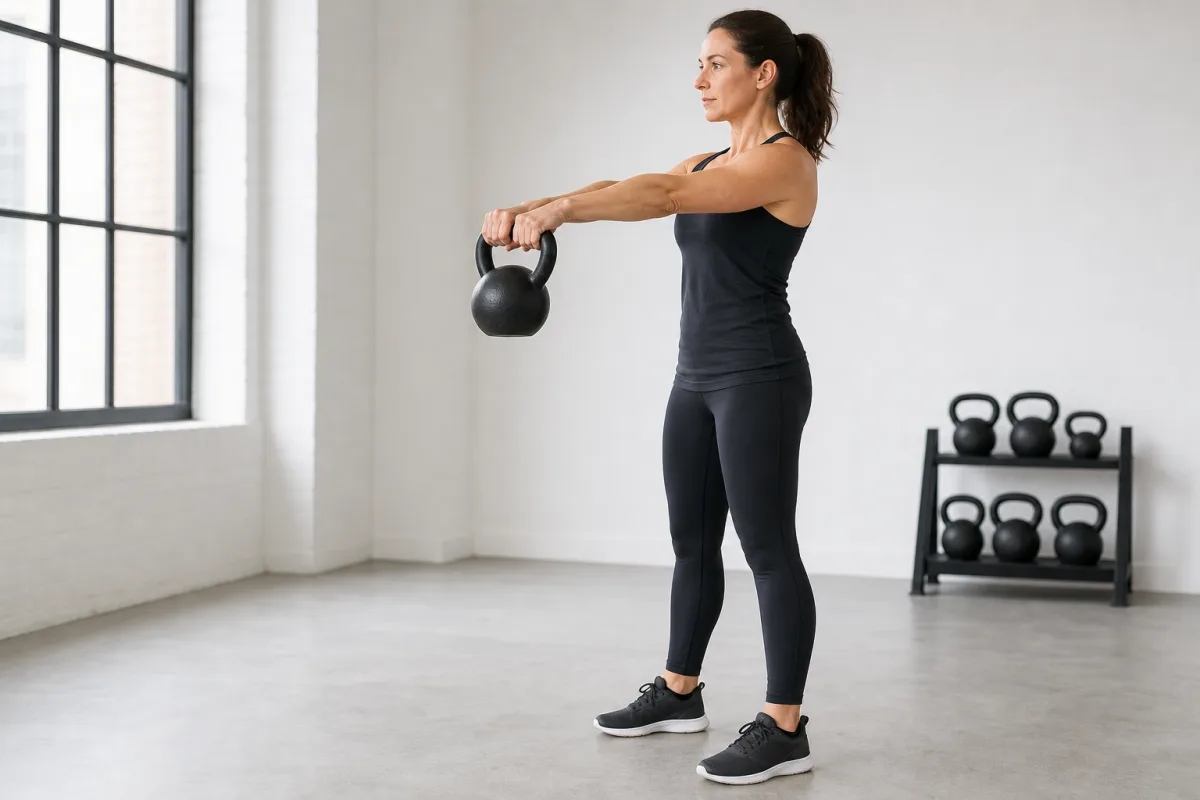
The swing is the exercise I reach for when a client has one piece of equipment, twenty minutes, and a posterior chain that's been asleep since high school. It builds glutes and hamstrings, hammers conditioning, and rehearses the exact hinge that protects your back every time you pick something up off the floor. It's also one of the most commonly butchered movements I see, which is why it has a reputation problem it doesn't deserve.
Is the Kettlebell Swing a Squat or a Hinge?
A hinge, and this single distinction is where most swings go wrong. The villain is the squat-and-lift swing you see all over gym floors: hips dropping straight down, knees shooting forward, and then arms hauling the bell up like a front raise. That version turns a ballistic hip exercise into a slow shoulder workout with a back strain waiting at the end of it.
In a true swing your hips travel back, your shins stay nearly vertical, and your chest hinges toward the floor while your spine stays long. If you can already perform a proper hip hinge, you're 80% of the way to a swing. If you can't, learn that pattern first, because the swing is just a hinge performed fast.
Stuart McGill's lab at the University of Waterloo, one of the most respected spine biomechanics groups in the world, analyzed the swing in a 2012 study in the Journal of Strength and Conditioning Research. They describe it as a hip-hinge pattern producing rapid cycles of muscle activation and relaxation, a unique loading style that most traditional lifts don't replicate.
Researchers at the University of Chichester in the UK, in the same journal, ran a six-week program of nothing but swing training. Maximal strength in the half squat improved by 9.8% and explosive strength measured by vertical jump improved by 19.8%. Six weeks, one exercise, double-digit gains in power.
Kettlebell training programs in workplace studies have also reduced neck and low back pain in adults with desk jobs, which tracks with what the swing actually trains: the ability to hinge and brace instead of rounding and hoping.
How Do You Do a Kettlebell Swing Step by Step?
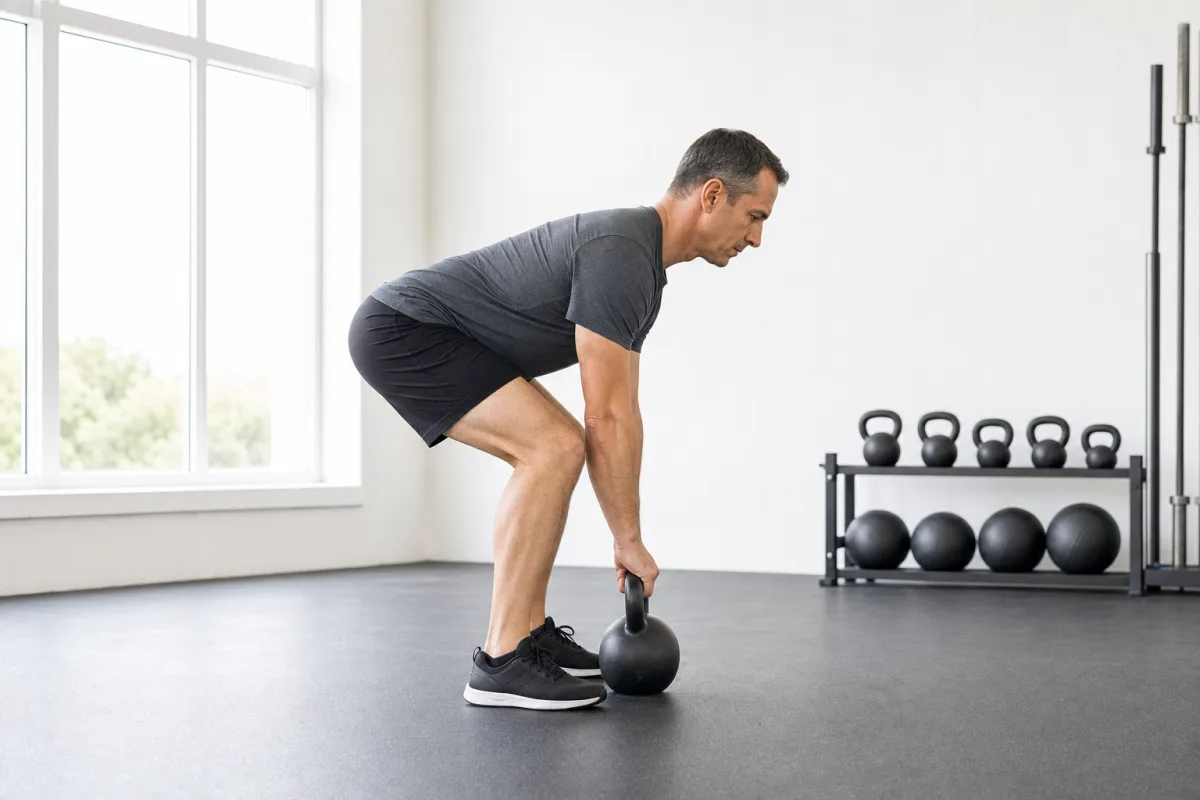
This is the two-handed Russian swing, bell to chest height. It's the version I teach every CoachCMFit client before any other kettlebell work.
- Set up. Feet shoulder-width, bell about 12-18 inches in front of your toes. Hinge back, grip the handle with both hands, and pull your shoulders down away from your ears. Your back is flat and your eyes are on the floor a few feet ahead.
- Hike it. Pull the bell back between your legs like a center snapping a football. Keep it high, forearms brushing your inner thighs. A low, dangling hike is what pulls people into a rounded back.
- Snap. Drive your hips forward hard and stand up fast. Squeeze your glutes like you're cracking a walnut. The bell floats up to chest height as a side effect. If your arms are lifting it, your hips didn't finish the job.
- Float. At the top you're a vertical plank: glutes tight, ribs down, arms relaxed. Don't lean back to push the bell higher. Chest height is the destination, not overhead.
- Ride it down. Let gravity take the bell. When your forearms touch your hips, hinge and let it pass between your legs into the next hike. The downswing is patience, not effort.
- Park it. On the final rep, let the bell swing forward and set it down in front of you with a flat back. Finishing sloppy after finishing strong is how last reps become injuries.
The breathing pattern matters more here than in slow lifts. Sniff air in through the nose on the downswing, then exhale sharply through pursed lips at the top of each snap. That rhythmic brace protects your spine rep after rep, the same principle I covered in how to breathe when lifting weights.
What Are the Most Common Kettlebell Swing Mistakes?
| Mistake | What It Looks Like | The Fix |
|---|---|---|
| Squatting the swing | Hips drop down, knees shoot forward | Practice hinges facing a wall: hips reach back to touch it |
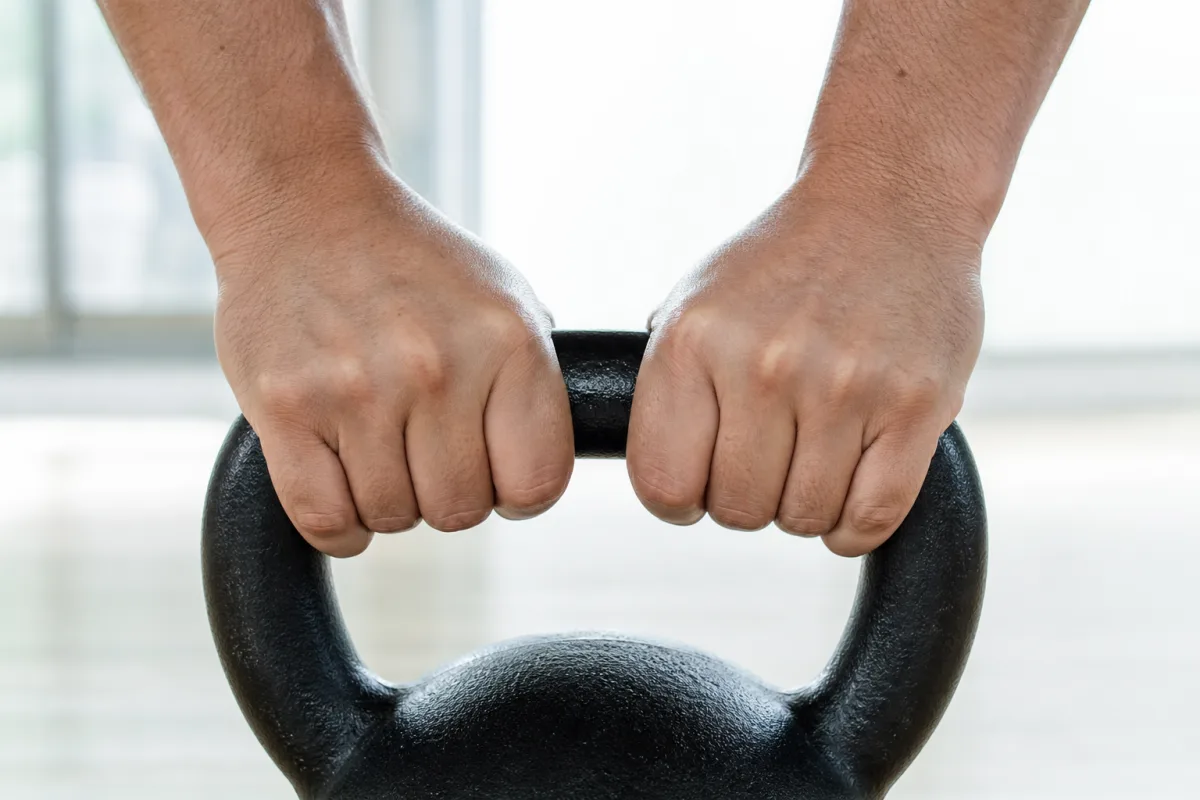
| Lifting with the arms | Bell muscled up past chest height | Think "arms are ropes." Hips throw, arms follow |
| Rounding the back | Shoulders collapse on the downswing | Hike high between the thighs, eyes a few feet ahead |
| Leaning back at the top | Ribs flare, lower back arches | Finish as a vertical plank: glutes squeezed, ribs down |
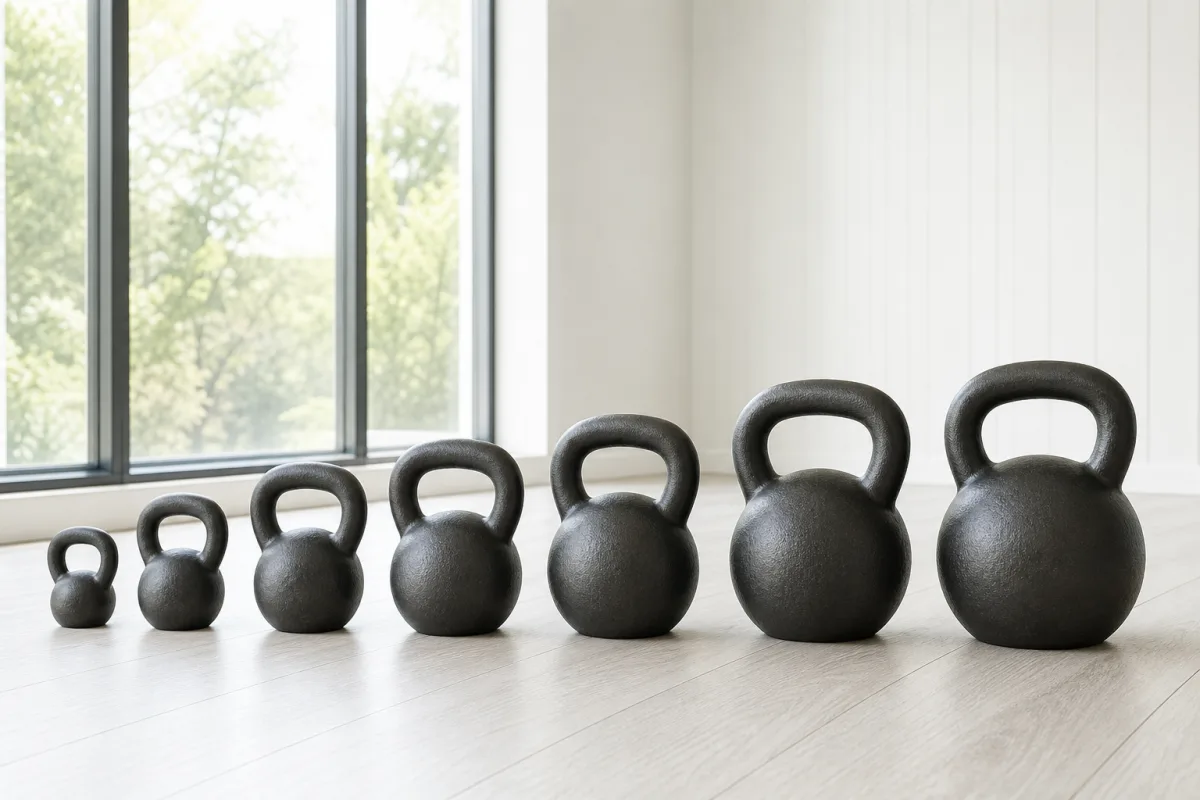
| Bell too light | No float, timing never develops | 16 kg for most men, 8-12 kg for most women, to start |
If your lower back pumps up or aches after swings, the pattern is the suspect, not the exercise. Rebuild the hinge with the Romanian deadlift at a slow tempo first, since it teaches the identical position with more control and less speed. The same diagnosis applies when your lower back hurts after squats: the pattern broke before the tissue complained.
How Do You Program Kettlebell Swings?
Swings are ballistic, so they're programmed in short, crisp sets that end before form decays. Inside CoachCMFit's Anchor + Accessory system, the swing usually lives as a conditioning finisher or as a power primer before lower body anchors, and it scales across the full 12-week periodization: sets of 10-15 in the Foundation block while the pattern is being learned, heavier bells for sets of 8-10 in Build, and interval formats in Challenge, like 20 seconds of swings and 40 seconds of rest for 10 rounds.
In 13 years of coaching at CoachCMFit, the swing has been my single favorite tool for busy clients, because ten minutes of quality swings delivers hinge strength and conditioning in the same session, and it slots straight into the best exercises to lose weight at home as the upgrade pick once the bodyweight hinge gets easy. Grip fatigue is usually what ends a set before the glutes are done, and that's a feature: swings quietly build the grip strength that carries over to deadlifts, rows, and stubborn jar lids.
- Master the unloaded hinge first: hips back to a wall, flat back, 2 sets of 10.
- Start with 16 kg (men) or 8-12 kg (women). Too light teaches bad timing.
- Do 5 sets of 10 crisp reps, resting 60 seconds, twice per week after your warm-up.
- Film one set from the side. Check for vertical shins and a flat back on the hike.
- Progress by adding 2 reps per set week to week, then move up a bell size when 5x15 is smooth.
- Stop any set the moment the snap loses its crack. Sloppy reps teach sloppy patterns.
The swing pays you back fast. Two focused sessions per week and within a month the hinge stops being a movement you think about and becomes one you own, with the glutes and the conditioning to show for it.