Knees caving in during a squat is usually a load problem and an ankle problem before it is a glute problem. Drop the weight, test your ankle dorsiflexion, then strengthen the hips. In that order, because the order is what most people get wrong.

I watched a client fight this for three months before I met her. She had been told to push her knees out, told to buy a band, told her glutes were asleep. Nobody had checked whether her ankles could bend far enough to let her squat in the first place. They could not, by a wide margin, and once we fixed that the knees stopped collapsing within a few weeks.
Knee valgus, which is the technical name for the inward collapse, has three common causes. Two of them get almost all the attention and the third gets almost none.
Why Do My Knees Cave In When I Squat?
Three causes, and you should check them in this order.
| Cause | How to Spot It | How Fast It Fixes |
|---|---|---|
| Load exceeds current control | Only happens on the last reps or heavy sets | Immediately |
| Ankle dorsiflexion restriction | Heels lift, torso pitches forward, fails the wall test | 2-4 weeks |
| Hip abductor weakness | Happens even bodyweight, worse on one side | 6-8 weeks |
If the collapse only shows up on your last two reps of a heavy set, that is not a mobility issue or a weakness issue. That is a load issue and the fix takes one second, which is taking weight off the bar. If it happens on a bodyweight squat in your kitchen, keep reading.
The villain is coaching by cue alone. "Push your knees out" is a good cue and it is not a fix. If your ankle physically cannot let your shin travel forward far enough, no amount of cueing changes the geometry. You just get a lifter who is thinking hard about their knees while their body finds the same workaround it always finds. Cues manage a pattern. They do not create the range of motion the pattern needs.
Is Knee Valgus Actually Dangerous?
Some inward travel out of the bottom of a heavy squat is normal and not an emergency. Repeated uncontrolled collapse is worth taking seriously.
Watch any elite powerlifter grind a maximal squat and you will see the knees drift in slightly as they fight out of the hole. That is a strong athlete under a load near their limit, and it is not the same thing as a knee that folds inward on rep one of a warm-up set.
Christopher Powers laid out the case in the Journal of Orthopaedic and Sports Physical Therapy in 2010, arguing that abnormal hip mechanics drive knee injury from above. Weakness in the hip abductors and external rotators allows the femur to rotate inward and adduct, which increases knee valgus and loads the patellofemoral joint in ways it does not tolerate well.
The clinical evidence lines up. Hip strengthening added to standard knee rehabilitation produces better pain outcomes than knee work alone in patellofemoral pain patients.
So the honest position is somewhere in the middle. A little valgus on a maximal effort is not a problem. A knee that consistently collapses under moderate load is a pattern worth changing, especially if you want to keep squatting for decades. If squatting already hurts, start with whether squats are bad for your knees before you load anything.
What Does the Research Say About the Ankle?
This is the part almost nobody checks, and the evidence on it is unusually clean.
A study from a University of North Carolina at Chapel Hill group, published in the Journal of Sport Rehabilitation in 2012, tested this directly. Researchers had participants perform double leg squats normally, then again while standing on a 12 degree wedge that artificially limited ankle dorsiflexion.
With the ankle restricted, participants showed increased knee valgus and increased medial knee displacement, along with decreased quadriceps activation and increased soleus activation. Same people, same squat, restricted ankle, knees collapsed inward.
That is a causal demonstration, not a correlation. Restrict the ankle and the knee caves. It follows that if your ankle is naturally restricted, whether from old sprains, tight calves, or years in heeled shoes, your squat is fighting the same handicap on every rep.
Test Your Ankles Right Now
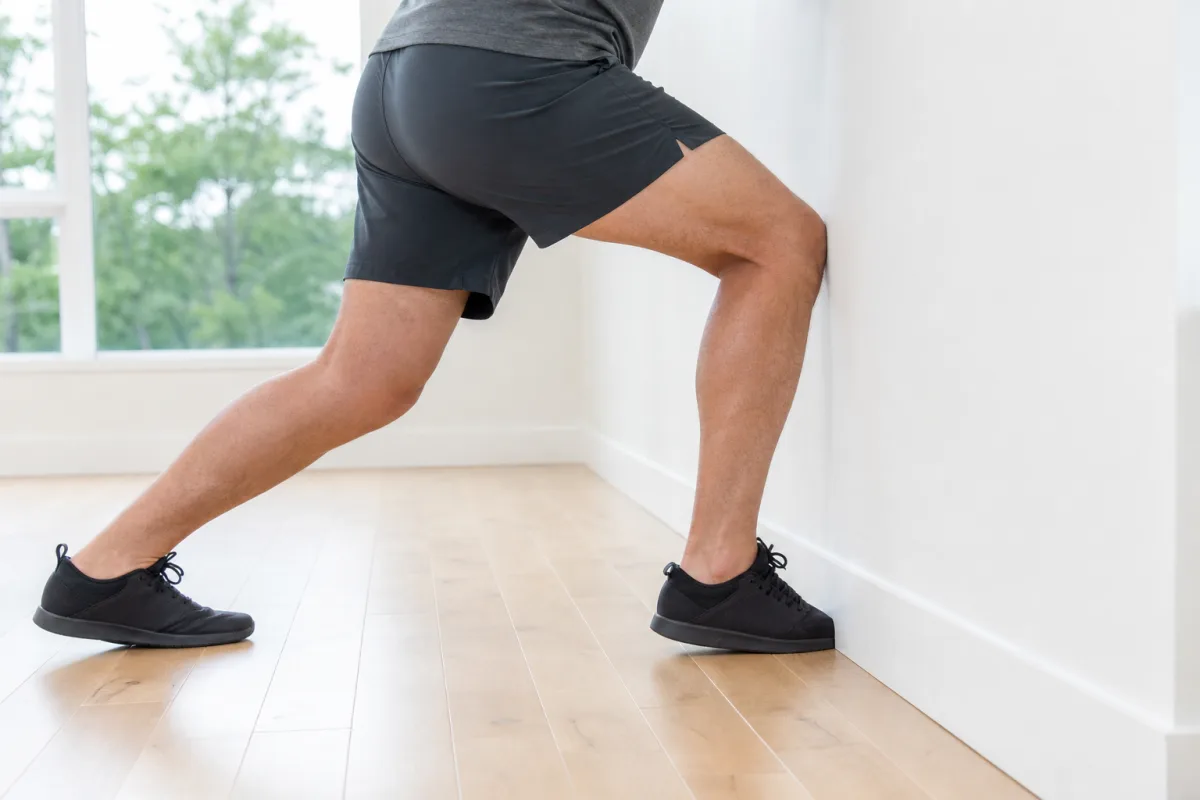
The knee-to-wall test takes fifteen seconds. Kneel in front of a wall with the toes of your front foot four inches back from it. Drive that knee straight forward toward the wall without letting the heel lift off the floor. If the knee touches the wall, your dorsiflexion is adequate. If it does not, you found a real limiter.
Test both sides. Asymmetry here is extremely common and it usually explains why one knee caves more than the other.
How Do You Actually Fix It?
Four steps, run together for four to eight weeks.
Drop the Load
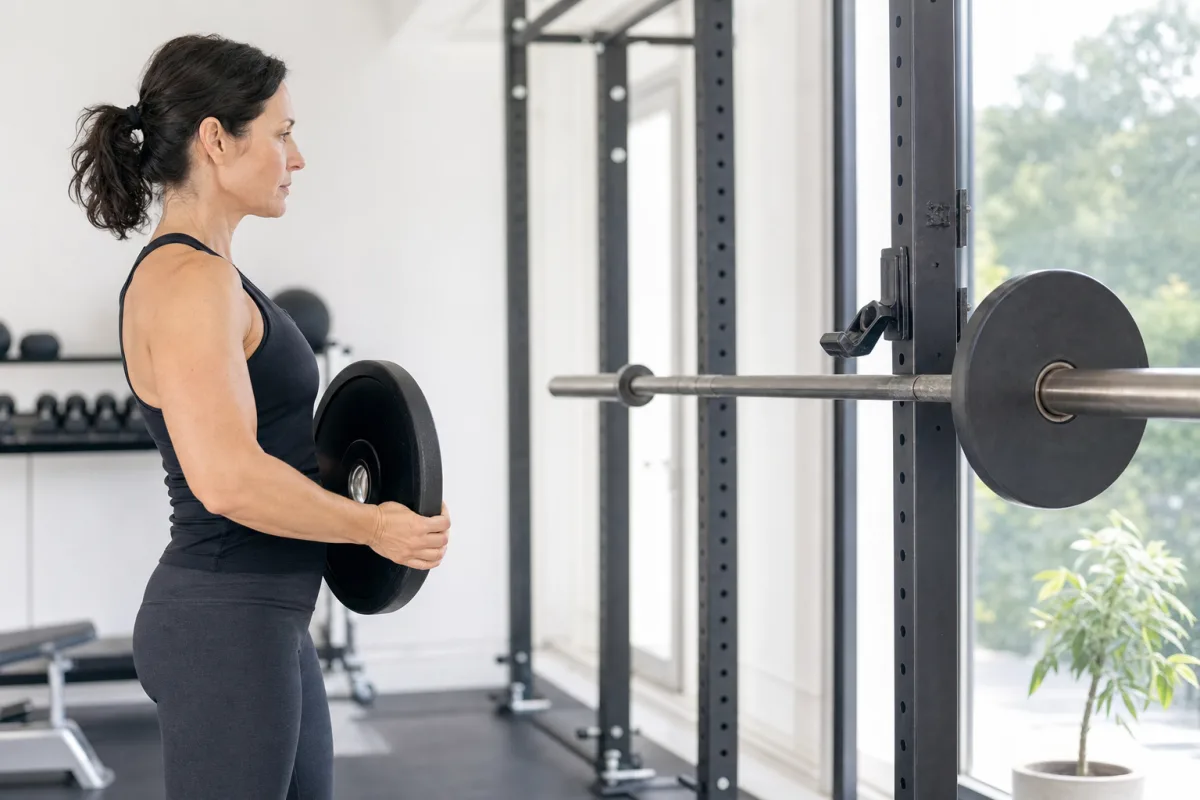
Cut to a weight you can control through the full range with no inward collapse, often 60 to 70 percent of what you were using. Every rep you grind with a caving knee is a rep spent teaching your nervous system that this is how squatting works.
Restore the Ankle
Ankle wall mobilizations, three sets of ten per side, daily. Calf stretching with a straight knee and a bent knee to hit both the gastrocnemius and the soleus. As a temporary bridge, elevate your heels on small plates or wear a lifting shoe, which buys you the range while you earn it.
Strengthen the Hips
Banded lateral walks, side-lying hip abduction, and single leg glute bridges. Two to three times a week, 2 to 3 sets of 12 to 15 per side. These go in the warm-up on lower body days, not tacked on at the end when you are already fried.
Retrain the Pattern
Goblet squats with a 3 second descent and a 1 second pause at the bottom. The tempo removes the ability to bounce out of the hole, which is where the collapse usually happens. Drive the knees out over the middle toes the whole way down and the whole way up.
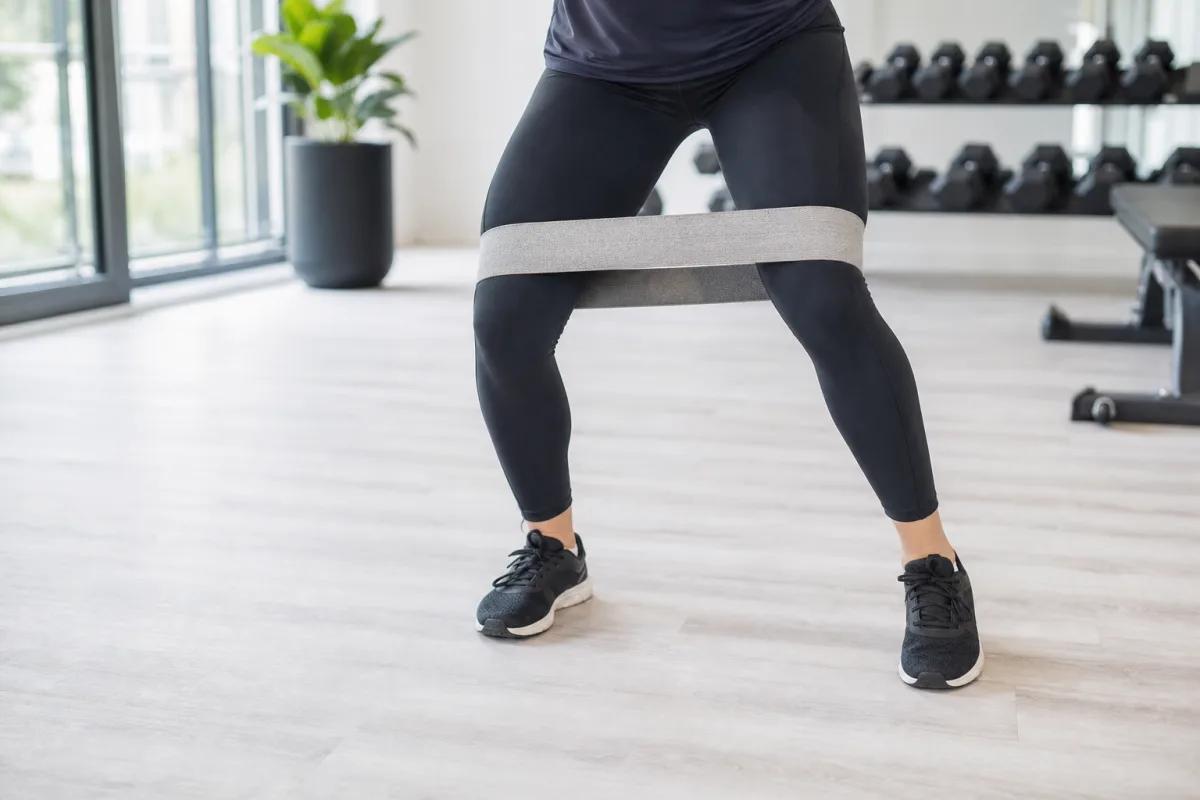
Warm-ups in every CoachCMFit program run four phases, Mobility, Dynamic, Activation, and Core, which is exactly where steps two and three live. Ankle wall mobilizations go in Mobility, banded lateral walks go in Activation. Nothing gets bolted on as homework, because homework does not get done.
How Does This Fit Into a Real Program?
The correction runs alongside your training, not instead of it.
In CoachCMFit's Anchor + Accessory system, the squat is an anchor lift, meaning it stays in the program for three to four cycles and carries the progression. You do not remove an anchor because of a form issue. You regress the variation, keep the pattern, and let the progression restart from a lower baseline.
| Weeks | Squat Variation | Why |
|---|---|---|
| 1-2 | Tempo goblet squat | Front load forces upright torso, tempo kills the bounce |
| 3-4 | Box squat to parallel | Controlled depth, no collapse zone at the bottom |
| 5-8 | Heel-elevated back squat | Buys ankle range while mobility work catches up |
| 9-12 | Back squat, flat shoes | Return to the full pattern with the range you earned |
Progression through those variations uses CoachCMFit's 6/6 Overload Rule. Six sessions at a given weight with clean form, meaning no inward collapse on any rep, earns the increase. If a knee caves, that session does not count and the weight stays. This is the part that actually protects people, because it makes clean execution the price of admission for adding weight rather than a suggestion.
Depth is worth its own conversation here too, since forcing depth you do not have range for is a fast way to create the collapse you are trying to fix. How to improve squat depth covers that, and how to squat with proper form covers the setup underneath everything on this page.

If it hurts, that changes the plan. Rate the pain from 1 to 10, note exactly where it is and when it shows up. Anything at 7 or above, or pain that is present at rest, means see a doctor or physical therapist before you keep loading it. Pain in the 3 to 6 range during specific movements means swap the movement and retest in two to three weeks. And skip the reflex to ice it every night, because whether ice baths help recovery is more complicated than it looks.
- Film your squat from the front. You cannot fix what you have not seen.
- Run the knee-to-wall test on both ankles today.
- Drop your working weight to a load where every rep is clean.
- Add ankle mobilizations to your warm-up daily, banded lateral walks three times a week.
- Run tempo goblet squats for two weeks, 3 seconds down, 1 second pause.
- Refilm at week four. Compare, do not guess.
The reason this problem persists for years is that people treat it as a willpower issue, something they should be able to cue away with enough focus. It is not. It is a range of motion problem stacked on a strength problem stacked on a load problem, and each one has its own fix and its own timeline. Work all three at once and most people are squatting clean inside two months. If one side is noticeably worse than the other, how to fix muscle imbalances and glute activation exercises are where to go next.
Restricted ankles are one of the most common upstream causes of this exact pattern, and the test plus the fix are in how to improve ankle mobility.