Sarcopenia is the progressive loss of skeletal muscle mass and strength, and resistance training is the only intervention with strong evidence for treating it. It typically begins around age 40, accelerates sharply after 70, and affects up to roughly 29 percent of older adults in community settings depending on the diagnostic criteria applied.
Here is the part that catches people. It is not a disease you catch at some point. It is a slope you have already been on for a while, and the only real question is how steep you let it get.
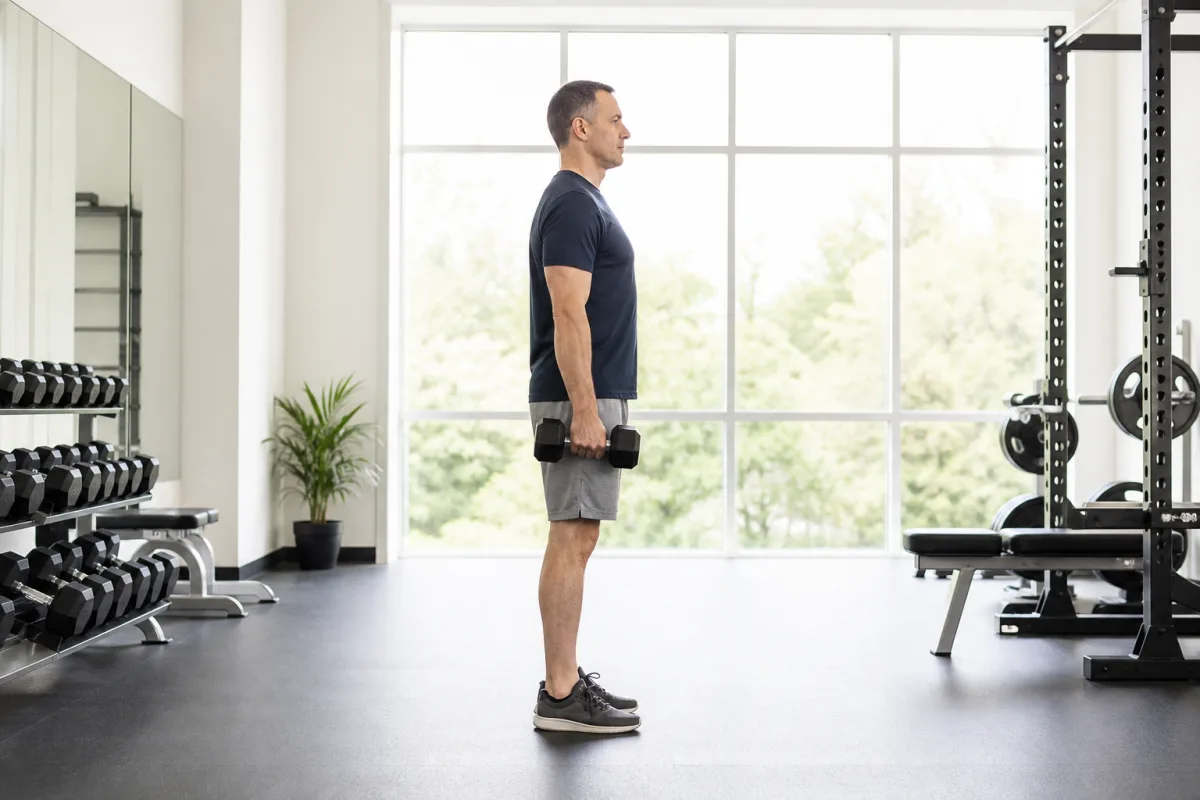
What made me start screening for this in the first session
There is a moment I watch for with every new client, and none of them know I am watching. When they sit down on a bench to take their shoes off or grab water, I watch how they stand back up. Whether the hands go to the knees. Whether there is a rock forward to build momentum. Whether it takes two attempts.
That single observation tells me more about someone's actual functional capacity than a body composition scan would. It is a loaded single-leg-ish task through a deep knee bend, performed unconsciously, without the performance pressure of being tested. It is honest in a way a formal assessment is not.
Nobody comes to me saying "I think I am losing muscle." They come in wanting to lose fat, or because a doctor mentioned bone density, or because their back hurts. The muscle loss is underneath all of it, unmentioned, and often the actual problem. Someone can be down 20 pounds on the scale and functionally weaker than when they started, and that outcome gets celebrated because the number moved.
This is why CoachCMFit's whole philosophy is built around muscle rather than the scale. Not because muscle is an aesthetic goal, though it can be, but because muscle is the tissue that determines whether you can carry your own groceries in twenty years. That is the actual product.
Why does nobody catch it early?
The villain is the bathroom scale, and specifically the assumption that a stable weight means a stable body.
You can lose meaningful muscle and gain an equivalent amount of fat and watch the scale not move by a single pound for a decade. The composition changes completely while the number reports that nothing is happening. By the time the scale reflects the problem, it has been running unopposed for years.
The second failure is that the standard advice given to anyone worried about aging is cardio. Walk more. Do some yoga. Take it easy on the joints. All of it reasonable, none of it a stimulus for building muscle. You can walk five miles a day and still lose muscle steadily, because walking does not present a load your body needs to grow tissue to handle. Walking is excellent and insufficient, both at once.
And the third is the belief that lifting is for people trying to look a certain way. That framing has probably cost more functional capacity than any other single idea in fitness. Resistance training is not a cosmetic hobby. It is the standard treatment for a condition that eventually costs people their independence.
What does the research say?
The European Working Group on Sarcopenia in Older People revised its definition in 2019, in the framework known as EWGSOP2. The significant change was making low muscle strength the primary indicator rather than low muscle mass. Sarcopenia is confirmed when low muscle mass is also detected, and considered severe when physical performance is affected as well. Strength declines faster than mass, so strength is the earlier signal.
Prevalence estimates reach up to 29 percent of older adults in community healthcare settings, varying substantially with the criteria used. In hospital populations, one comparison found 15.79 percent by EWGSOP2 criteria and 13.59 percent by the alternative FNIH definition.
Muscle loss generally begins around age 40 and accelerates after 70, with more than half of adults over 80 affected.
Across the treatment literature, resistance exercise is the standard non-pharmacological treatment for sarcopenia, carrying the strongest positive evidence of the available options. Adequate nutrition, particularly protein, supports it but does not substitute for it.
The detail I want to sit on is EWGSOP2 leading with strength instead of mass. It reframes the entire problem. This is not primarily about how much muscle you have. It is about how much force you can produce, and those two things come apart as people get older. You can hold onto reasonable muscle size while losing a disproportionate amount of strength and power, particularly fast, forceful movement.
Which has a direct programming consequence. If strength and power go first, then training that only ever uses light weights for high reps is addressing the wrong quality. Gentle is not the same as appropriate.
How do you screen yourself?
None of these are diagnostic. They are prompts to pay attention.
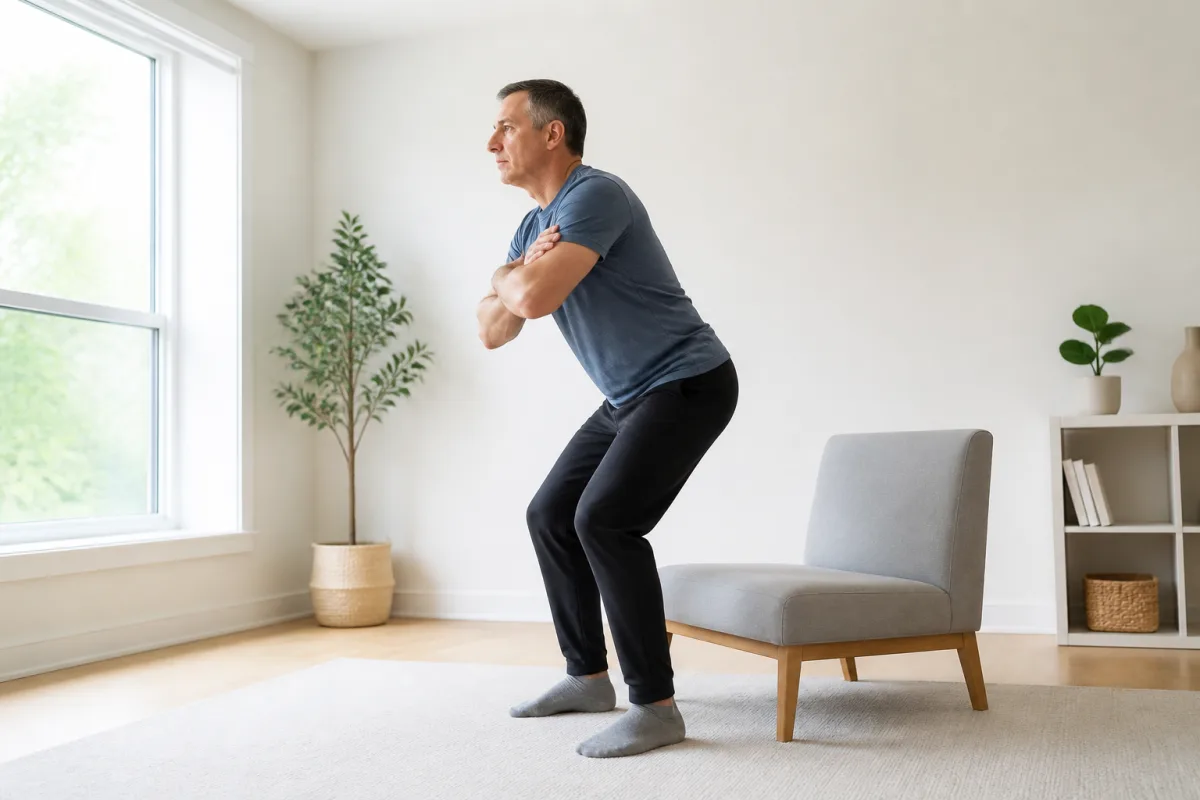
- Stand from a chair without your hands. Arms crossed over your chest, five times in a row. Struggling with this is the single most useful signal on the list.
- Open jars and carry bags. Grip strength is one of the better proxies for whole-body strength, and it declines early.
- Notice your walking pace. Slowing down, particularly finding yourself passed by people who used to walk your speed, is a recognized marker of physical performance decline.
- Count grocery trips. When one trip becomes two, that is a functional capacity change, not a scheduling preference.
- Watch the stairs. Reaching for the handrail when you did not used to is information worth having.
Any of these showing up is not a crisis. It is early enough to matter, which is the whole point of screening for something that starts at 40 and gets loud at 70.
The training that actually addresses it
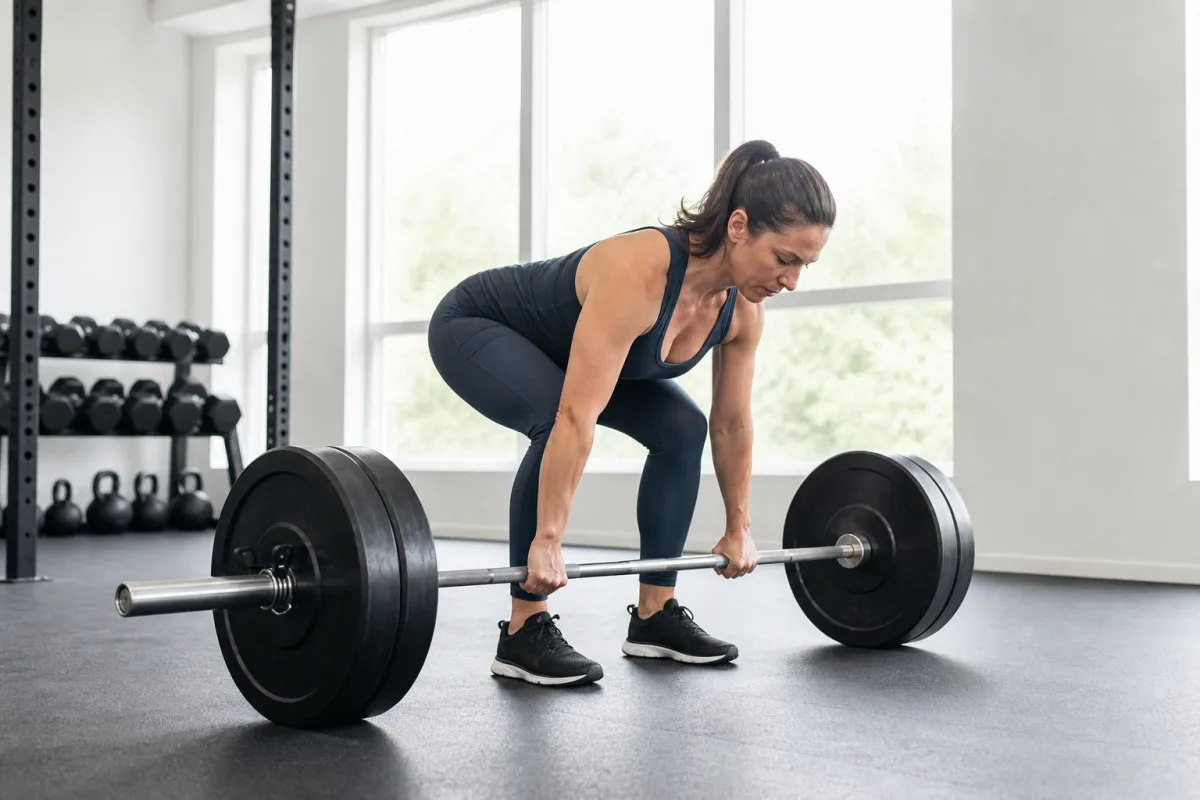
CoachCMFit's 12-Week Periodization System handles this in three four-week blocks, and the block structure exists precisely because you cannot start someone at the intensity that eventually produces the result.
| Block | Weeks | Reps | What it targets |
|---|---|---|---|
| Foundation | 1-4 | 12-15 | Movement patterns, connective tissue, the habit |
| Build | 5-8 | 8-12 | Muscle size, working capacity, real load |
| Challenge | 9-12 | 6-10 | Strength and force production, the quality lost first |
Block 3 is the one that matters most for this specific problem, and it is the one most programs written for older adults never include. If strength is what you are losing, then at some point you have to train heavy enough to build strength. Not recklessly, and not in week one. But eventually, and on purpose.
Progression runs on CoachCMFit's 6/6 Overload Rule. Six sessions at a weight with clean technique earns the increase. Miss one and the counter resets. It sounds almost too simple, and that is the feature: it removes the guessing that makes people either stall for years or jump too fast and get hurt, which are the two ways this goes wrong.
Power work deserves a specific mention. Fast, forceful movement declines earlier and faster than raw strength, and it is what you need when you catch a toe on a curb. That means loaded step-ups, controlled jumps and landings when appropriate, and moving moderate weights with genuine intent to accelerate. It gets screened and scaled per person, but for most people it should not be absent entirely.
And protein supports all of it without replacing any of it. Raising intake without adding load does not appear to improve muscle health. The training is the signal. The food is the supply.
The honest framing
I am not going to tell you that lifting weights makes you immune to aging. The slope is real and it is not optional.
What the evidence supports is that the slope's steepness is highly modifiable, that muscle tissue responds to loading at every age tested, and that the standard treatment for the condition is available to you at any gym for the price of showing up twice a week. Ninety to 120 minutes weekly is the dose.
Most people start thinking about this at 65, when it has become obvious. The people who start at 40, while nothing appears to be wrong, are the ones who never have the conversation at 65.