Ninety to 120 minutes of strength training per week is the dose with the strongest evidence behind it. That is two sessions of roughly 50 minutes, or three of about 35. A 30-year analysis of 147,374 adults published this summer in the British Journal of Sports Medicine found that people who trained in that range had a 13 percent lower risk of dying early, and that the benefit stopped climbing after about two hours a week.
Two hours. That is the whole ask. Less time than most people spend deciding what to watch on a Sunday.

I want to be careful with the word "dose" here, because a mortality curve is not a training program. It tells you how much, not what. The what still has to be built. But the how much is the question I get asked more than any other, and for the first time there is a number worth quoting.
Why I stopped selling people more days in the gym
The free starting program I built for CoachCMFit is 14 days long and contains six workouts. Six. Total. No gym, no equipment purchase, nothing you have to sign up for. I built it that way on purpose, and it took me years to get comfortable with how small it looks.
Early in my career I did the opposite. Someone would tell me they wanted to change their body and I would hand them five days a week, because five days a week sounds like it means I take them seriously. What actually happened is that they did four days for two weeks, missed a Thursday, felt like they had blown it, and then missed the following Monday too. The program did not fail on the training floor. It failed on the calendar.
So now the on-ramp is six workouts across two weeks, and the graduation gate is completion, not performance. Finish the fourteen days and you have earned the next level. That is it. The number of people who finish something small and then ask for more is dramatically higher than the number who survive something ambitious.
I am also living the other side of this right now. I am training around a patellar tendon issue, which means my own leg work has temporarily regressed to weighted wall sits, four sets of 20 to 30 seconds with the knee bent somewhere between 70 and 90 degrees, loaded with a plate until the hold sits at about an 8 or 9 out of 10 in effort. Two to three minutes of rest between holds. That is not the athletic session I want to be doing. It is the one that keeps the tendon progressing instead of flaring. Volume you cannot recover from is not volume. It is just fatigue with better branding.
What is wrong with the "more is always better" model?
Here is the villain. Fitness marketing has spent two decades convincing people that the correct amount of training is "as much as you can stand," and that anything less means you did not want it badly enough. Six-day splits. Two-a-days. The whole aesthetic of grinding.
That model was built for and by people whose job is training. It was never built for someone with a commute, two kids, and a job that occasionally runs long. When you hand that person a six-day plan, you have not given them an ambitious program. You have given them six chances a week to feel like a failure.

The deeper problem is that volume is the easiest variable to add and the hardest to recover from. Adding a fourth and fifth day feels productive because it is visible. Adding five pounds to a bar you have handled for four weeks feels like nothing, and it is the thing that actually drives the result. That is why progressive overload matters more than attendance. Showing up more often without ever increasing the load is running in place, sweatier. It is also how people end up needing a deload they never planned for.
And there is a cost nobody prices in. Every hour you spend training is an hour you did not spend sleeping, cooking, or recovering. At some point the marginal hour in the gym starts competing with the inputs that make the gym work at all.
What does the research actually say about weekly training volume?
A 30-year analysis published in the British Journal of Sports Medicine pooled three long-running cohorts: the Health Professionals Follow-up Study, the Nurses' Health Study, and the Nurses' Health Study II. Across 147,374 participants, 90 to 119 minutes per week of resistance training was associated with a 13 percent lower risk of all-cause mortality, a 19 percent lower risk of cardiovascular mortality, and a 27 percent lower risk of neurological disease mortality. Beyond roughly 120 minutes per week, the association did not continue to improve.
The same analysis found that combining resistance training with regular aerobic activity was associated with approximately a 45 percent lower risk of death, a substantially larger effect than either mode on its own.
The American College of Sports Medicine published a new Position Stand on resistance training in March 2026, its first major update since 2009. Built on 137 systematic reviews covering more than 30,000 participants, it concluded that the largest gains come from moving from no resistance training to any resistance training, and it recommends training all major muscle groups at least twice weekly. For strength specifically it points to heavier loads near 80 percent of a one-rep max for 2 to 3 sets, and for size roughly 10 sets per muscle group per week.
A University of Queensland study following more than 8,000 Brisbane adults over nine years found that adults doing both aerobic and muscle-strengthening activity were less likely to develop a range of chronic diseases than those doing either alone.
Read those together and a clear shape emerges. The first hour of training a week is worth enormously more than the fifth. The floor matters more than the ceiling. And strength work and cardio are not competitors, they are a pair.
One honest caveat, because it matters. These are observational cohorts, so they show association rather than proof of cause. People who lift for two hours a week tend to differ from people who lift zero in ways that go beyond lifting. Researchers adjust for what they can measure. Still, when three decades of data across nearly 150,000 people point the same direction, and the mechanism makes physiological sense, that is about as good as this kind of evidence gets.
What I find most useful is the ceiling. A plateau past 120 minutes is permission. You are not falling behind by training twice a week and doing it well.
How do you build a week that hits the target?
Ninety to 120 minutes is a budget. Here is how CoachCMFit spends it.
Two days a week: two full-body sessions, roughly 50 minutes each, hitting a squat pattern, a hinge, a push, and a pull every session. Every major muscle group gets trained twice weekly by default, which is exactly what the ACSM Position Stand asks for.
Three days a week: three sessions of about 35 to 40 minutes. Either full body again, or an upper, lower, full rotation. More frequency per pattern, less fatigue per session.
Four days a week: only once two or three days have been genuinely consistent for a couple of months. Upper, lower, upper, lower. This is a preference, not an upgrade.
Inside those sessions, CoachCMFit's Anchor + Accessory system decides what stays and what rotates. The anchors are your big compounds, one squat, one hinge, one push, one pull, and they hold for three to four cycles so you can actually accumulate load on them. The accessories rotate every six sessions to keep things fresh without ever disturbing the lifts that drive progress. When everything changes at once, nothing progresses.
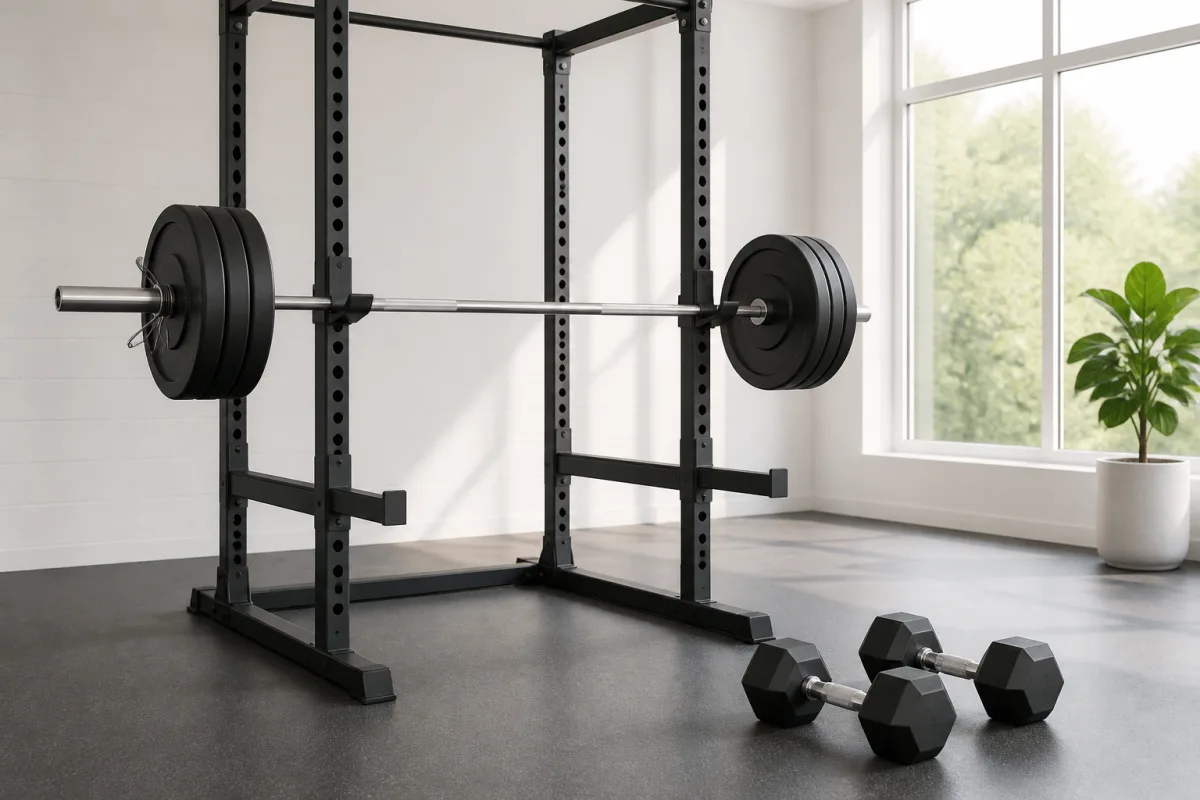
Progression runs on CoachCMFit's 6/6 Overload Rule for newer lifters. Six sessions at a given weight. Hit all six with clean technique and you earn the increase, five to 10 pounds on a barbell, 2.5 to five on dumbbells. Miss one and you stay, and the counter resets. It removes the daily "should I go up today" negotiation, which is where most people either stall for a year or jump too fast and tweak something.
All of it sits inside CoachCMFit's 12-Week Periodization System, three blocks of four weeks:
| Block | Weeks | Reps | What it does |
|---|---|---|---|
| Foundation | 1-4 | 12-15 | Learn the patterns, build the habit, gather the data |
| Build | 5-8 | 8-12 | Add load, add supersets, the body starts changing |
| Challenge | 9-12 | 6-10 | Heaviest weights of the cycle, final week ends in an all-out set |
Notice that the weekly time commitment does not change across the twelve weeks. The intensity does. That is the entire point of periodizing, and it is why the number of days you train is a much less interesting question than what happens across those days over three months.
What about the cardio half?
The 45 percent figure is the one I would tattoo on a gym wall if I were the tattooing type. Strength plus aerobic work, together, tracked to roughly triple the mortality benefit of strength work alone in that analysis.
The good news is that the aerobic half is the cheap half. Most of it does not need to happen in a gym at all. Twenty to 30 minutes of brisk walking on the days you are not lifting covers a lot of ground, and easy conversational-pace work is where most of the cardiovascular return lives anyway. You do not have to be miserable for it to count.
If you are already walking daily and lifting twice a week, you are hitting both halves of the strongest finding in this entire body of research. That is not a beginner position. That is the target.
Your first four weeks

- Pick two fixed days. Same two days every week, written down. Not "twice a week when I can." Consistency of slot beats consistency of intention.
- Build each session around four patterns. A squat, a hinge, a push, a pull. Three sets each, 12 to 15 reps to start. That is your Foundation block and it takes about 45 minutes.
- Write down every weight. You cannot run the 6/6 Overload Rule from memory. A notes app is fine. The log is the program.
- Add a third day only after four honest weeks. If both days happened every week for a month, you have earned the option. If they did not, adding a day fixes nothing.
- Walk on the off days. Twenty minutes, brisk enough that talking takes a little effort. This is the half of the equation that doubles the return.
- Stop at 60 minutes. Including warm-up. If the session is running long, the problem is usually rest periods drifting, not that you need more work.
Four weeks of that puts you at the low end of the evidence-backed range. Twelve weeks of it, with the load climbing, puts you somewhere most people never get to, which is actually trained rather than merely active.
The number is 90 to 120 minutes. The ceiling is real. Two focused hours a week, done for years, beats six ambitious hours a week done for five weeks in January, and it is not close.