The sauna produces a real but modest recovery benefit: less soreness, better perceived recovery, and a smaller drop in performance the next day. It will not build muscle, burn meaningful fat, or rescue a training week you did not sleep through. It is a useful finishing touch on a program that already works.
Recovery gets talked about backward. People ask me about saunas, cold plunges, massage guns, and compression boots long before they have a consistent bedtime or a training plan that schedules its own rest. I am not against any of those tools. I am against buying the last five percent while the first eighty percent is still missing, and that is the order almost everyone reaches for them in.
With that said, the sauna has better evidence behind it than most of the recovery aisle. Here is what the research actually supports.
What Do the Trials Say About Sauna and Recovery?
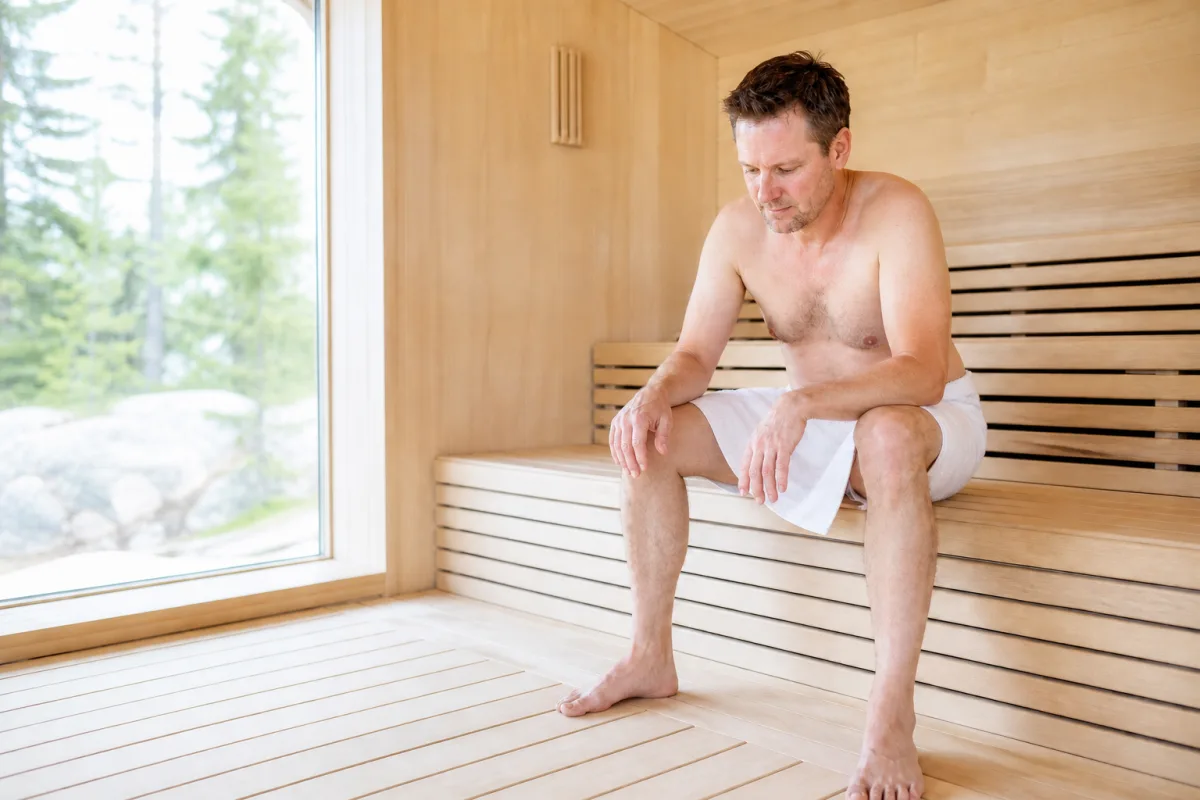
The most directly relevant study is a randomized crossover trial in 16 male basketball players. After a resistance exercise session, participants either sat in an infrared sauna at roughly 43 degrees Celsius for 20 minutes or took passive recovery, then got measured again 14 hours later.
The infrared sauna condition produced less severe muscle soreness, higher perceived recovery, and a smaller decrease in countermovement jump performance at the 14-hour mark than passive recovery did. One session, measurable next-day difference.
A broader systematic review in Sports Medicine Open examining post-exercise heat exposure across acute recovery and training adaptations found the effects are real but depend heavily on the type of heat, the duration, and what kind of training preceded it. Far-infrared exposure after strength work has produced no measurable advantage in some protocols while helping after endurance work in others.
So the honest read is a small positive effect with meaningful variability, not a settled protocol. That is a normal state of affairs for recovery research and it is fine. A tool that reliably makes tomorrow's session feel better is worth having even if the effect size is modest.
Worth noting where the effect showed up: soreness and perceived recovery, which are subjective, plus jump performance, which is not. The jump number is the one that makes this more than placebo.
What About the Heart Health Claims?
This is where the sauna's reputation actually comes from, and the underlying data is genuinely impressive.
The Kuopio Ischemic Heart Disease Risk Factor Study at the University of Eastern Finland followed 2,315 Finnish men for a median of 20.7 years. Published in JAMA Internal Medicine in 2015, the analysis found that men who used a sauna four to seven times per week had a 63 percent lower risk of sudden cardiac death and a 50 percent lower risk of fatal cardiovascular disease compared with once-weekly users.
Those numbers are large, and they come with a large asterisk. This is an observational cohort, not a controlled trial. In Finland, frequent sauna use travels with a certain kind of life: more leisure time, more social connection, better baseline health. Researchers adjust for what they can measure, and they cannot measure everything. The association is strong and the causal claim is not proven.
I bring it up because the fitness internet regularly presents that 63 percent as if a randomized trial produced it. It did not, and repeating it that way is exactly the kind of overclaiming that makes people distrust the useful stuff too.
What Will the Sauna Not Do?
It will not burn fat. The pounds that disappear during a session are sweat, and they return the moment you rehydrate. Your heart rate rises because your body is working to shed heat, not because you are training a cardiovascular system, and those two things produce different adaptations. If the scale after a sauna is confusing you, how water weight actually works explains what you are watching.
It will not replace sleep. Nothing does, and sleep is the single largest recovery variable most people are ignoring while they shop for tools. I laid out why in sleep and muscle growth, and I would rather someone fix a 5-hour night than add a heat protocol on top of it.
It will not fix a program that is asking too much of you. Persistent soreness, stalled lifts, and disrupted sleep are signals about training volume, not signals to add recovery modalities. Those symptoms belong to the overtraining conversation, and the answer there is fewer hard sets, not more heat.
How Does This Fit a Real Training Week?

At CoachCMFit, recovery is a programming decision before it is a tool decision. Every 12-week cycle has deloads built into it on a schedule, and the plan reduces volume before your body demands it. That is the part that actually protects a training year. The sauna sits on top of a structure like that, not in place of one, and the deload guide covers how the scheduled version works.
CoachCMFit's Program First, Tools Last Rule
When a CoachCMFit client reports feeling beat up, the first three things I look at are logged training volume, sleep, and protein intake. Only after those check out do I care what recovery tools they own. In 13 years of coaching I have never once seen a sauna rescue a program that was running someone into the ground, and I have repeatedly seen a two-set volume reduction do it inside a week.
- Go after training, never before, so you do not compromise the session that produced the stimulus.
- Stay 15 to 20 minutes, the range used in the recovery trials, and leave if you feel lightheaded.
- Rehydrate deliberately afterward, with sodium if you sweat heavily or the session ran long.
- Two to four times a week is plenty. More is not obviously better and it eats time you could spend sleeping.
- Skip it if you are already dehydrated, unwell, pregnant, or managing a cardiovascular condition without clearance from your physician.
Heat or cold? If you are training for muscle and strength, heat is the safer default. Cold immersion right after lifting can blunt the inflammatory signaling that drives adaptation, which is a real tradeoff rather than a rumor. I walked through the evidence in whether ice baths help recovery, and the timing details matter more there than most people realize.
Use the sauna because it feels good, it takes the edge off soreness, and it gives you twenty quiet minutes with no phone. Those are real benefits and they do not need inflating. Just do not let it become the thing you do instead of the recovery basics, because the boring inputs are still where nearly all of the result comes from.