Fix neck pain from lifting by correcting the setup errors that make your upper traps take over, then loading that muscle directly with light, progressive work rather than stretching it. The tissue that hurts is almost always underworked and overused at the same time, which sounds contradictory until you see how it happens.

Right now I am eight weeks into a block of my own training that pulled running, jumping, loaded hinging, and deep single-leg work out of my program to protect a cranky knee. I kept training six days a week the whole time. That experience is the reason I have very little patience for the advice that tells people to rest a sore area and wait. Waiting rarely fixes anything, and it costs you every bit of momentum you built.
Neck pain from lifting responds to the same approach: change what is causing it, keep training everything else, and load the painful tissue on purpose.
What Actually Causes Neck Pain From Lifting?
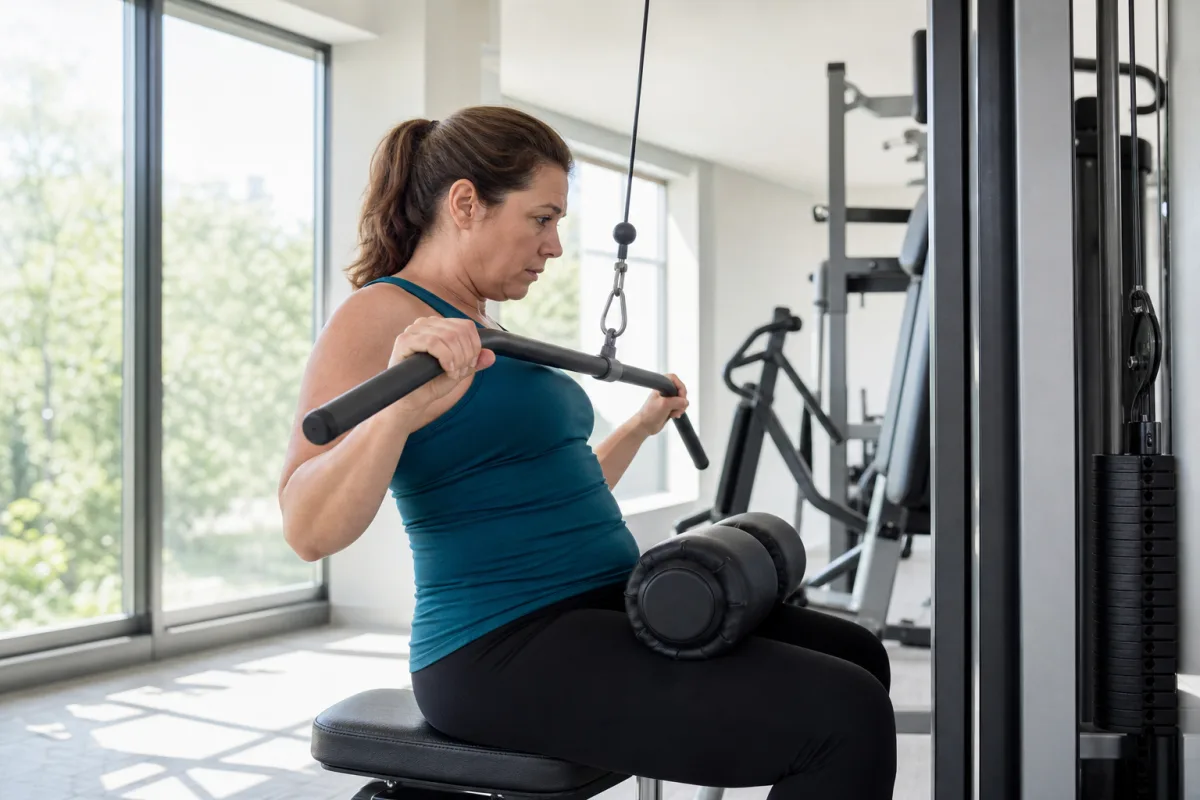
Your upper trapezius runs from the base of your skull out to the tip of your shoulder. Its job is to elevate and upwardly rotate the shoulder blade, and it is very willing to do other muscles' work when they are not participating. That willingness is the whole problem.
Five setup errors cause most of it:
- Shrugging under load. Your shoulders creep toward your ears during rows, pulldowns, and presses instead of staying set.
- Chin leading. Your head pokes forward to initiate a pull, so the neck starts the movement the back should start.
- Mirror watching. Craning to check your form under a heavy press puts the neck in extension exactly when it is loaded.
- Bar placement on squats. A bar sitting on bare traps with no shelf built means the muscle is bracing against a steel bar for the entire set.
- Upright rows and heavy shrugs done badly. Both are fine exercises. Both get turned into neck exercises by momentum and a head thrust.
Underneath the errors sits a posture problem most people bring in from their desk. When the head sits forward of the shoulders for nine hours, the upper traps spend the day holding it there and arrive at the gym already fatigued. That is the pattern I see most often, and it is why fixing desk job posture does more for neck pain than any single gym cue.
Why Does Strengthening a Painful Muscle Work Better Than Stretching It?
This is the part that reverses people's instincts, and the evidence behind it is unusually clean.
Researchers Lars Andersen and Gisela Sjøgaard at the National Research Centre for the Working Environment in Copenhagen recruited 94 women from seven workplaces, all clinically diagnosed with trapezius myalgia. They compared supervised specific strength training for the neck and shoulder muscles against high-intensity general fitness training on a bike and against health counseling.
The specific strength training group's pain reduction was described by the authors as of major clinical importance. General cardio training did not produce the same effect. Their conclusion: high-intensity dynamic strength training of the painful muscle, three times a week for 20 minutes, should be recommended in the treatment of trapezius myalgia.
A follow-up randomized trial from the same group examined how frequency and duration change the result, and a separate trial found that scapular function training also reduced chronic neck and shoulder pain. Different research angles, same direction: the shoulder blade region needs to get stronger, and the painful muscle is not off limits.
There is a mechanical reason this works. Muscle tissue in chronic trapezius pain shows a shift toward fast-twitch fibers with reduced endurance capacity, so the muscle fatigues under exactly the low-grade sustained loads that daily life keeps applying. Building endurance in that tissue changes what it can tolerate. Stretching does not.
What Is the Fix, Exactly?

Two things happen at once. You remove the aggravation and you add the loading. Skipping either half is why most people's neck pain keeps coming back after a good week.
| Stop Doing | Replace With | Why |
|---|---|---|
| Barbell upright row | Cable face pull | Same region trained, no impingement position, no head thrust. |
| Heavy barbell shrugs | Dumbbell shrugs, 12 to 15 reps, paused | Lighter load with a controlled hold trains endurance instead of grinding. |
| High bar squats on bare traps | Safety bar, front squat, or a built shelf | Removes direct bar pressure on the tender tissue. |
| Overhead press while looking up | Landmine press, eyes level | Keeps the neck neutral through the whole rep. |
| Wide-grip pulldowns pulled with the chin | Neutral grip pulldown, chest leading | Puts the lats in charge of the pull instead of the neck. |
The squat swap deserves a note. If the bar digs into bare tissue, the problem is usually that the shelf was never built, and squatting with proper form covers how to set the upper back so the bar has somewhere solid to sit.
Then the loading side. Three sessions a week, roughly 20 minutes of direct work, built out of prone Y raises, dumbbell shrugs held at the top for two seconds, face pulls, and a simple chin nod against light resistance. Two to three sets of 12 to 15 reps each. Start lighter than your ego prefers, because the goal in week one is to finish without the area barking the next morning.
CoachCMFit's 2:1 Pull-to-Push Ratio
Whenever a client has anything going on in the neck or shoulder region, I run two pulling sets for every pushing set until it resolves, with face pulls in every upper body session. Most people arrive with the opposite ratio because pressing is what feels like training. The correction alone often changes how the neck feels within two weeks, before any specific neck work has had time to matter. I use the same approach for shoulder impingement, which shares most of its causes with this.
If you have never been coached through the face pull, it is worth getting right, because a sloppy one trains the same problem you are trying to fix. The face pull technique guide covers the elbow height and the finish position, which are the two details that decide whether it works.
How Do You Know When to Stop and See Someone?

At CoachCMFit every pain report gets the same three questions before I change a single exercise. Where exactly does it hurt, when does it hurt, and where does it sit from 1 to 10. Those three answers separate a muscle that needs work from a problem that needs a professional.
- Pain at 3 to 6, only during certain movements, tender to press: swap those movements, add the loading protocol, keep training.
- Pain at 7 or higher, or pain present at rest: stop the aggravating work and get assessed by a physician or physical therapist.
- Numbness, tingling, weakness, or pain traveling down an arm: this is not a trap problem. Get it looked at before your next session.
- No change after four consistent weeks: the plan is wrong, or the diagnosis is. Either way it needs a second set of eyes.
What to expect: most simple upper trap overload settles inside two to four weeks once the setup is corrected and the loading starts. The people who stay stuck are almost always the ones who stretched it, felt better for an hour, and never changed the thing that caused it.
One more piece worth handling while you are at it. Rounded shoulders and a forward head travel together, and they load the same tissue from the same direction all day long. Working on rounded shoulders in parallel removes the background tension the gym then adds to, which is often what turns a manageable ache into something that lingers for months.