Yes, and the effect size is larger than almost anything else you can do for free. A systematic review and meta-analysis published this month in the American Journal of Cardiovascular Drugs pooled nine studies covering 480,479 people and found that regular stair climbing was associated with a 39 percent lower risk of cardiovascular death and a 24 percent lower risk of death from any cause.
No membership. No commute. No outfit. Just the thing next to the elevator that everybody walks past.
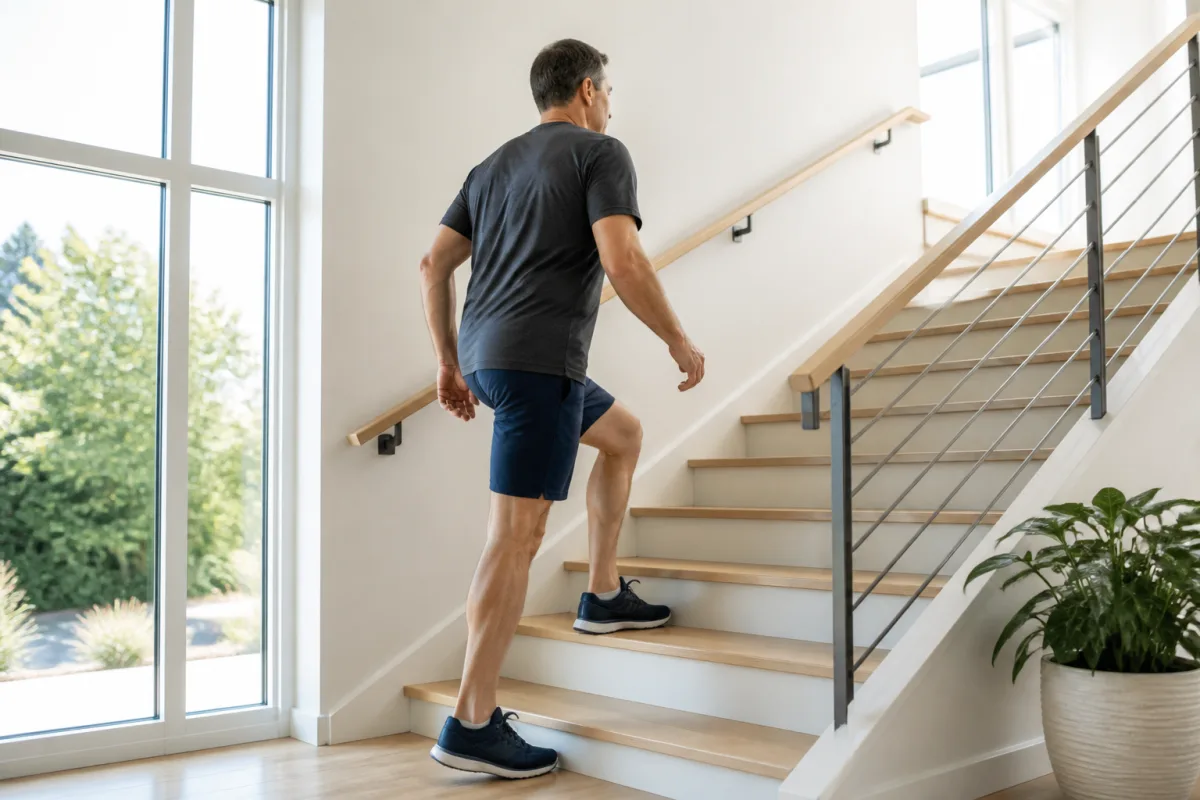
The most underrated thing I ask new clients to do
When someone tells me they have no time to train, I do not start by negotiating for gym days. I start by asking what their building looks like, whether their office is on the second floor, and how many times a day they take an elevator they could walk.
It is not a consolation prize. It is a diagnostic. The answer tells me whether this person's problem is genuinely a schedule problem or an activation problem, and those need completely different solutions. Someone who works twelve-hour shifts and still takes the stairs every time is a scheduling puzzle. Someone with an open calendar who rides the elevator one floor is telling me something else, and no amount of program design fixes it.
The other reason I like stairs is that they are the closest free thing to what I actually want people doing. A stair is a step-up. A step-up is a single-leg loaded knee bend, which is one of the movement patterns I care most about in the CoachCMFit level system because it builds the unilateral leg strength and balance that carry into everything from hiking to getting off the floor. You are doing a training movement whether you intend to or not.
I am not doing much of it myself at the moment. I am working around a patellar tendon issue and my leg work has temporarily regressed to loaded wall sits while the tendon rebuilds capacity. Stairs will come back. That is what a regression is, a detour rather than a verdict.
Why does nobody take the stairs?
The villain here is not laziness. It is the way buildings are designed. Elevators sit in the lobby under good lighting and stairwells get tucked behind a fire door at the end of a hallway, often unheated, often ugly. The default path is engineered to be the effortless one, and defaults win.

The second problem is that stairs do not feel like exercise, so they do not get counted. There is no app celebrating them, no class, nothing to post. A generation of fitness culture has taught people that activity only counts when it is a designated event with the right clothes on, which quietly writes off most of the movement available in an ordinary day. That is the same reasoning that makes people undervalue non-exercise activity, which across a week adds up to far more than any single workout.
And there is a specific fear worth naming: the belief that stairs wreck your knees. It is mostly backwards. Cartilage is nourished by movement, and the muscles that protect a knee joint get stronger by being loaded. Avoiding stairs to protect your knees usually produces weaker legs and a more sensitive joint. Control the descent, but do not skip the exercise.
What did the 2026 analysis actually find?
A systematic review and meta-analysis published August 13, 2026 in the American Journal of Cardiovascular Drugs, led by Sophie Paddock at Norfolk and Norwich University Hospital, pooled nine studies covering 480,479 participants. Stair climbing was associated with a 39 percent lower risk of cardiovascular death (relative risk 0.61, 95% CI 0.48 to 0.79) and a 24 percent lower risk of all-cause mortality (relative risk 0.76, 95% CI 0.62 to 0.94).
Stair climbers also showed lower rates of heart attack, ischemic stroke, and heart failure across the pooled data.
One large cohort inside the analysis suggested that roughly six flights per day may be where the benefit concentrates, though the authors were explicit that the optimal dose is not yet settled.
Now the part most coverage skipped. These are observational cohorts, which means association rather than proof of cause, and there is an obvious confound sitting right in the middle of it: people who habitually take the stairs are often people who are already healthier, and healthier people can climb stairs more easily. Some of that 39 percent is almost certainly reverse causation. The researchers adjust for what they can, but nobody has randomized half a million people into stair groups.
So I would not promise you a 39 percent risk reduction for taking the stairs. What I would say is that the direction is consistent across nine studies, the mechanism is entirely plausible, the cost is zero, and the downside is nothing. That combination does not come along often.
How do you actually use stairs as training?
There are two separate ways to use them and most people conflate them.
Take every stair you already encounter. Parking garage, office, home, the station. You are not adding time to your day, you are changing a default. Target roughly six flights daily, accumulated however it happens. This is the lane the research is describing.
A stairwell as a training tool. Five to 10 minutes of continuous climbing, walking down as recovery. This gets your heart rate into a genuinely useful range and doubles as leg conditioning. Start at five minutes. It is harder than it sounds.
Lane 1 is the one CoachCMFit builds into a client's week first, and it pairs naturally with a daily step target rather than competing with one. Lane 1 is where almost everyone should start, because it requires no decision and no scheduling. Lane 2 is a real workout and should be treated like one, meaning you do not do it the day after a hard leg session and expect to feel good.
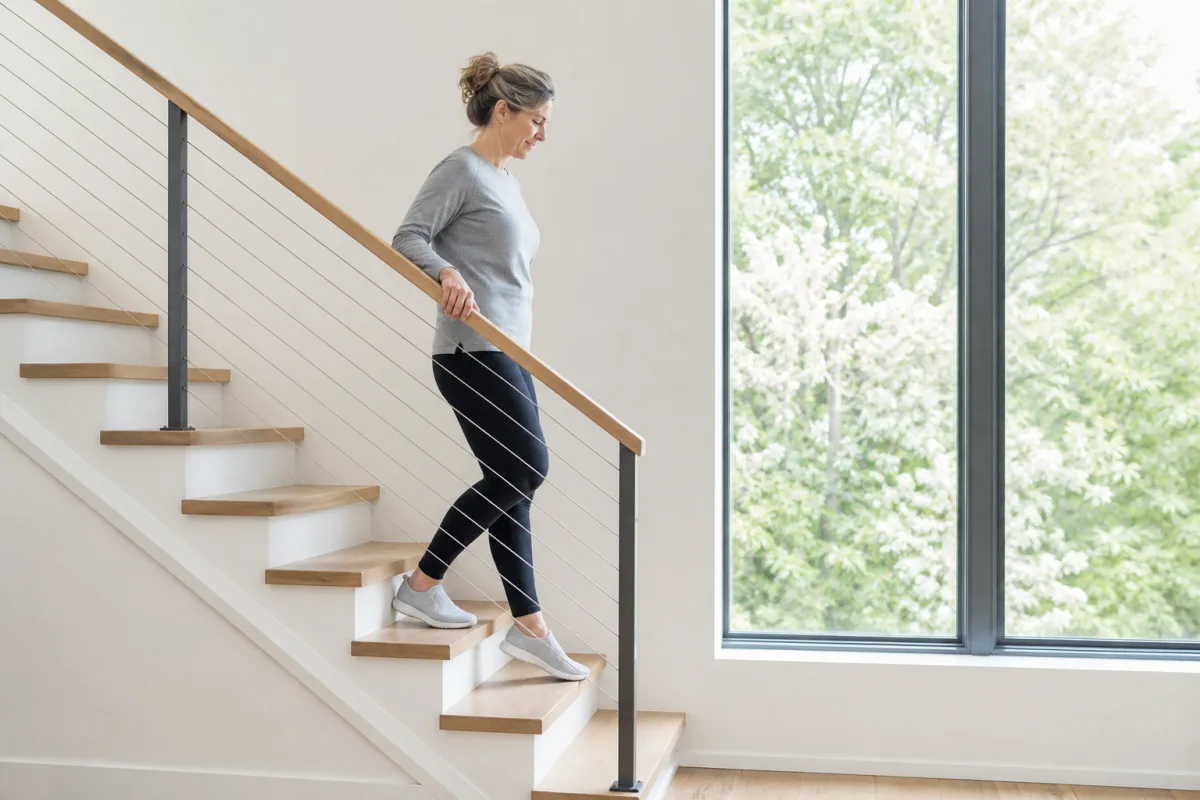
On the descent: walk down under control, place your whole foot on each step rather than the ball, and use the handrail if it helps. Going down produces higher forces through the knee than going up, and it is where most stair-related complaints come from. If your knees are already cranky, take the stairs up and the elevator down for a few weeks. That is a legitimate modification, not a cop-out.
What stairs will not do
They will not build your upper body. They will not train a hinge pattern, which means your hamstrings and glutes stay largely unaddressed. And they are one fixed range of motion repeated, so the strength you build is narrow.
This is why I file stairs under conditioning, not strength. The pairing that shows up over and over in the mortality research is aerobic activity plus resistance training, and stairs cover one half of it well and the other half barely at all. Two structured lifting sessions a week is the dose that covers the rest.

- Stop riding elevators for three floors or fewer. One rule, no tracking, applies everywhere. This alone gets most people close to the target.
- Count your building. Find out how many flights you naturally encounter. You need a baseline to know whether six is a stretch or already handled.
- Control every descent. Whole foot, handrail available, no bounding. Protect the joint you need for the next thirty years of this.
- Keep two lifting days. Stairs are the cardio half. They do not replace resistance training and were never going to.
- Add load after four weeks. Once daily flights are automatic, a backpack with 10 to 15 pounds turns your commute into progressive overload.
The best exercise is not the one with the best research behind it. It is the one already built into your day that you have been walking past. In this case those happen to be the same thing.