Morning training works when you remove every decision from the morning itself. Clothes out the night before, session written in advance, a longer warm-up for a cold body, and a fixed wake time you hold on weekends. The workout is the easy part. The setup is what fails.

This is the companion to the morning workout routine itself. That article covers what to do. This one covers why 5 AM feels impossible and what to change so it stops being.
In 13 years of coaching at CoachCMFit, almost nobody who quit morning training quit because the workout was too hard. They quit because they were cold, stiff, underslept, and had to make four decisions before 6 AM with a brain that was not online yet.
Why Does Working Out in the Morning Feel So Bad?
Because physiologically, it is genuinely harder. This is not weakness and it is worth knowing.
Core body temperature swings about 1 degree Celsius across the day, hitting its lowest point around 4 to 6 AM and peaking in the late afternoon. Muscle strength, power output, and reaction time track that curve, peaking roughly 4 to 8 PM. A cooler body means slower nerve conduction, stiffer connective tissue, and less force available.
The encouraging part is that this rhythm is trainable. Consistent morning training shifts your performance peak earlier over a matter of weeks, so the gap between your 6 AM self and your 6 PM self narrows the longer you keep the schedule.
So week one feels rough because it is rough. That is temporary and it is not a verdict on whether you are a morning person.
How Should You Warm Up a Cold Body?
Longer than you would in the afternoon, and this is the single highest-return change on this list. Most morning injuries I have seen came from someone loading a bar four minutes after getting out of bed.
| Phase | Time | What |
|---|---|---|
| Raise | 4-5 min | Brisk walk, bike, or stair laps. Goal is warmth, not fitness |
| Mobilize | 3 min | Hip circles, thoracic rotations, ankle rocks, shoulder pass-throughs |
| Activate | 2 min | Glute bridges, band pull-aparts, dead hangs |
| Ramp | 3-4 min | Two build-up sets of your first lift at 40% and 60% |
Twelve to fourteen minutes. Yes, that is a real bite out of a 35-minute window, which is exactly why the working session is only four movement patterns. Do not trade the warm-up for an extra exercise in the morning. Full protocol in how to warm up before lifting.
Should You Eat Before a Morning Workout?
For a 35-minute strength session, training fasted is fine for most people, and it is one less thing to organize. If you feel lightheaded or your last set collapses, you need something small.
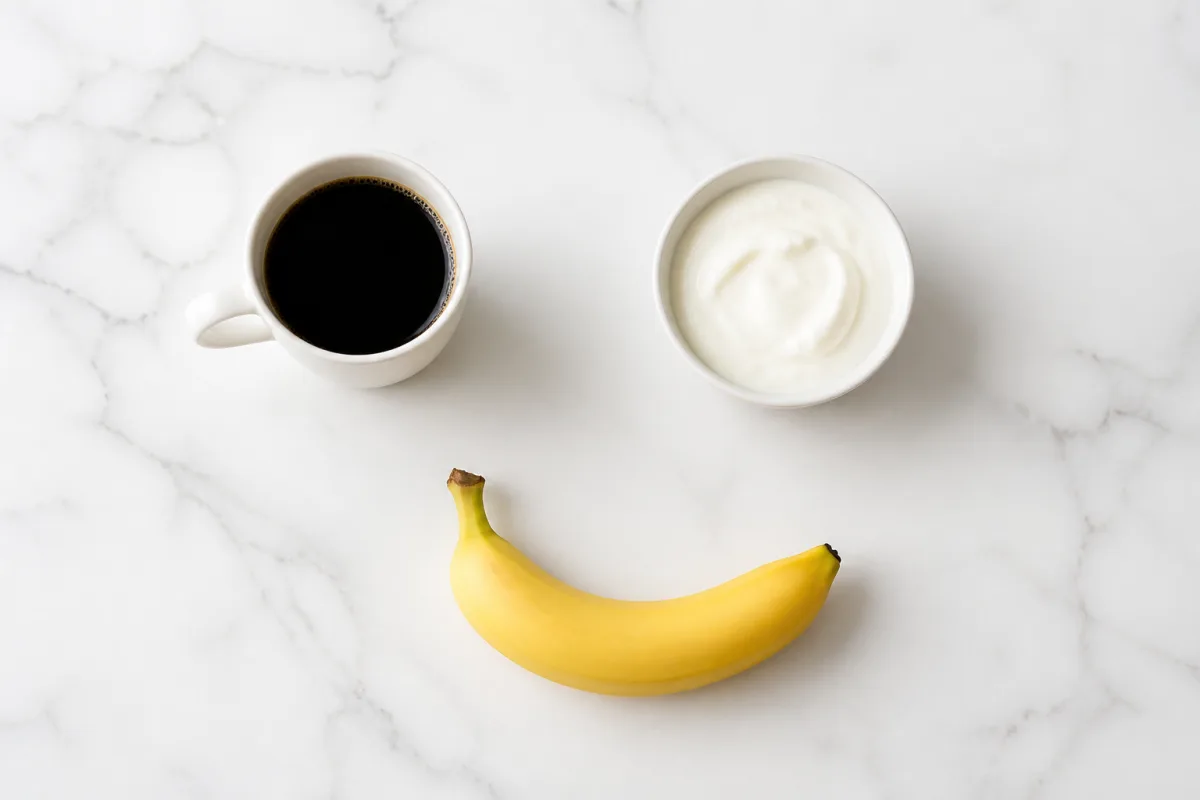
What works, in order of how little it asks of you: black coffee alone, coffee plus a banana, or coffee plus a small serving of yogurt. Twenty to thirty grams of carbohydrate about twenty minutes out is plenty. A full breakfast before lifting sits in your stomach and makes the session worse.
What matters far more is the protein afterward. Get 30 to 40 grams within a couple of hours of finishing, which is easy to build into breakfast at your desk. The timing science is in does protein timing matter and what to eat before and after a workout.
How Do You Actually Wake Up Earlier?
By moving bedtime first. This is the part everyone skips and it is the part that decides the outcome.
Setting a 5 AM alarm without changing when you fall asleep is not building a habit, it is scheduling sleep deprivation. Sleep loss lowers strength, wrecks recovery, raises appetite, and blunts the muscle you are training to build. A morning routine that costs you an hour of sleep a night is a net loss no matter how disciplined it looks. The mechanism is in how much sleep you need to build muscle.
The 14-Day Shift
Move your wake time earlier by 15 minutes every three days, not all at once. Hold the new wake time on weekends, since sleeping in on Saturday resets the adaptation and you start Monday from scratch. Two weeks gets most people from 7 AM to 6 AM without losing sleep, because bedtime drifts earlier on its own once the wake time is fixed.
What Do You Set Up the Night Before?
Everything that requires a decision. The goal is that your morning self has to execute, never choose.
- Clothes and shoes out, in the room you will walk into, not the one you are sleeping in
- The session written down, exercises and starting weights, so you are never standing there deciding
- Water bottle filled, coffee set up to a single button press
- Bag packed if you train at a gym, keys and card already in it
- Phone charging across the room, which handles the alarm and the scrolling in one move
Every one of those removes a decision from a moment when you are least equipped to make one. That is the whole principle, and it generalizes well beyond training, which is why it also shows up in how to build a workout habit.

What If You Sleep Through the Alarm?
You train that evening, or you take the day and hit the next scheduled session. What you do not do is treat one missed morning as evidence that mornings do not work for you.
This is the failure point I see most often. One skipped Tuesday becomes a story about being a night person, and the whole structure gets abandoned over a single data point. Three sessions a week means you can miss one and still hit every muscle group twice. The plan already has slack built in. Use it instead of quitting. More on riding out that stretch in how to stay consistent working out.

- Set your wake time and move it earlier by 15 minutes every three days, holding it on weekends.
- Lay out clothes, shoes, and a filled water bottle tonight. Not tomorrow night, tonight.
- Write tomorrow's session on paper with exercises and starting weights.
- Budget 12 minutes for the warm-up and protect it. Cut an exercise before you cut the warm-up.
- Give it six weeks before you judge it. The first two weeks are the adaptation, not the result.
The honest framing is that morning training is not physiologically superior. It is logistically superior, because nothing has happened yet to take the time away from you. Set the mornings up so they run without decisions and the schedule holds. Leave them to willpower and it will not.